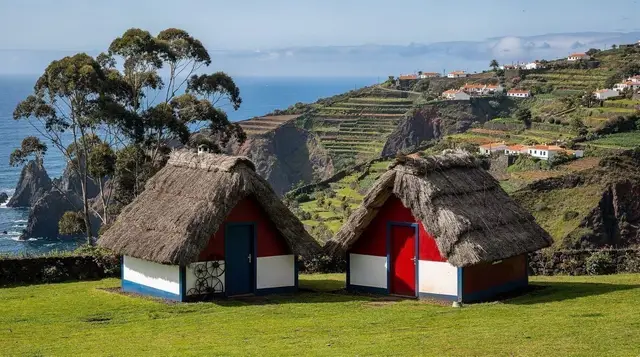
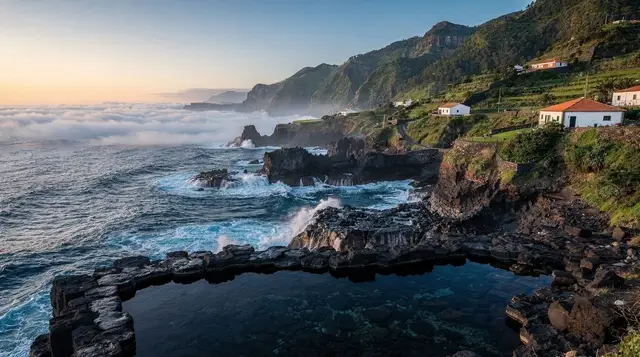
São Jorge does not try to be a destination, and that is more or less the point of stopping there. It sits on Madeira’s north coast between São Vicente and Faial, on the same stretch of the ER101 that carries most north coast day trips past cliffs, waterfalls and terraced slopes on the way to Santana. Guides that promise São Jorge a museum, a market or an adventure-sports centre are inventing one: it has a church, a scatter of houses on a shelf above the sea, and fields worked into the hillside on both sides of the road. That is the whole offer, and for a north coast drive it is often enough.
Where São Jorge sits on the coast
The village occupies a natural terrace on Madeira’s north-facing slope, roughly midway between the volcanic caves of São Vicente to the west and the sheer rock of Faial to the east. The coast here is steep and green rather than sunbaked, the product of moisture-laden Atlantic weather meeting the island’s mountain spine. Where the south coast around Calheta and Ribeira Brava is dry and terraced for bananas, the north around São Jorge is wetter, and its terraces carry vines, maize and vegetables instead.
The parish stretches from the cliff edge inland towards Arco de São Jorge and up towards Boaventura, but the part travellers see is the small cluster of houses the road threads through, with the church tower as the obvious landmark. There is no seafront promenade or harbour to head for — the village faces the Atlantic from a height, with the water visible below rather than lapping at a shoreline you can walk down to.
The drive in: what you will actually see
Coming from Funchal, the fast way north is the VR1 through the central tunnels to Santana, then west along the ER101. Coming the other way, from Porto Moniz or São Vicente, the ER101 hugs the coast in a sequence of curves, cuttings and short tunnels that is itself the main attraction of this stretch of Madeira. São Jorge announces itself with a widening in the terraces, a run of cultivated slopes dropping towards the cliff edge, and then the road drops slightly into the village.
This is a road built for a coastline, not for speed, and it rewards going slowly. Pull-offs are limited and often unmarked, so the sensible approach is either a self-drive with patience for reversing to a safe spot, or a seat in an organised vehicle where someone else does the stopping. A number of operators run north coast circuits that pass directly through this stretch: a Porto Moniz to north coast 4x4 tour that threads this exact stretch of coastline, São Jorge included covers the corridor from Porto Moniz through São Vicente, São Jorge and on towards Santana in a single day, which suits anyone who would rather watch the road than drive it.
The village itself, in twenty minutes
There is not much of a centre to São Jorge in the way that Funchal Old Town or Santana have a centre. A handful of streets, a school, a few cafés that keep local rather than tourist hours, and houses stepped down the slope towards the cliff. Walking from one end to the other takes perhaps fifteen minutes, and there is no obligation to walk further than that: the village is small enough that a short loop past the church and back to the car covers what there is to see.
What stands out is less any single building than the setting — terraces above and below the road, the sea a long way down, and a quietness that is unusual this close to a coast road most rental cars use at some point during a north coast day. Unlike Porto Moniz or the cave complex at São Vicente, nobody has built São Jorge a car park, a ticket office or a gift shop, and that absence is worth naming rather than glossing over: this is a working village that a road happens to pass through, not a stop laid on for visitors.
The church that outshines the village
If São Jorge has one thing worth deliberately seeking out, it is the parish church, dedicated to Saint George, standing at the heart of the small settlement. From the outside it is a modest whitewashed building of no great size. Inside, when it is open, it holds a gilded Baroque interior — carved and gilded woodwork, an ornate altarpiece — that feels disproportionate to a village of this size, and is often cited by anyone who does stop as the one genuine surprise São Jorge has to offer. Opening hours are informal and tied loosely to services, so treat access as a possibility to check on arrival rather than something to plan a schedule around.
It is worth comparing this honestly with its neighbours rather than inflating it. São Jorge’s church is a detour for people already passing through, not a reason on its own to add thirty minutes to a north coast itinerary that would otherwise take in São Vicente’s caves or the thatched houses of Santana.
Terraces, water and the levada next door
The slopes around São Jorge are worked in the same pattern found along most of Madeira’s wetter north coast: narrow terraces cut into the hillside, retained by dry stone walls, fed by gravity-driven irrigation channels drawn from streams higher up. This is the visible end of the levada system that defines so much of the island — not the tourist-facing walking trails of the Rabaçal or Ribeiro Frio, but the working, everyday version that keeps small plots of vines and vegetables productive on ground too steep to farm any other way.
São Jorge itself is not the trailhead for an official PR walking route. The nearest one, the Levada do Rei, starts a short drive further along the coast at Boaventura, and is worth treating as a separate outing rather than something to combine casually with a São Jorge stop — it has its own access arrangements, its own tunnel sections, and like every official trail on the island it now carries a paid permit under the scheme introduced in 2021.
For those planning to add it to a north coast day: a guided Levada do Rei walk with transfer, starting from the trailhead near Boaventura covers the logistics of getting to and from a trailhead that is awkward to reach without a car of your own.
What São Jorge is not — and where to read about it instead
It is worth being direct about what this village does not have, because guidebooks and search results routinely conflate it with its neighbours. São Jorge is not São Vicente, which lies a short drive west and holds the volcanic lava tubes and the island’s volcanism interpretation centre — see the São Vicente caves guide for that. Nor is it Faial, a few minutes east, known for the sheer rock of the Penha de Águia rising straight out of the village — covered on the Faial page. São Jorge has no caves, no eagle rock, no interpretation centre and no dedicated walking trail starting from within the village boundary.
| Village | What it is known for | Where to read more |
|---|---|---|
| São Vicente | Volcanic lava caves, volcanism centre | São Vicente, caves guide |
| São Jorge | Cliffside setting, terraces, a Baroque church | This page |
| Faial | The Penha de Águia rock formation | Faial |
| Santana | Thatched triangular houses (casas de colmo) | Santana, thatched houses guide |
Treating São Jorge as a fifteen-to-twenty-minute link between these places, rather than as a destination competing with them for a full stop, is the honest way to plan around it.
Fitting São Jorge into a north coast day
The most sensible way to see São Jorge is inside a longer loop rather than as a dedicated trip. A typical north coast day from Funchal runs through the central tunnels to Santana, along the coast through São Jorge and São Vicente to Porto Moniz, then back via the Paúl da Serra plateau or the same coast road in reverse. São Jorge’s role in that day is a short pause, not a headline stop, which is exactly why self-drive travellers so often miss it altogether, distracted by the more heavily signposted attractions on either side.
For travellers who would rather not manage the driving on this stretch — narrow sections, occasional rockfall closures, and a road that punishes distraction — a guided jeep circuit removes the decision-making: a valleys-and-viewpoints jeep tour that takes in this side of the island’s terraces and coastline covers similar terraced-valley terrain further inland, useful for comparing the coastal terraces around São Jorge with the inland ones on the same trip.
If wine is part of the plan for the day — and the terraces around São Jorge are a visible reminder of how much of the north coast still grows for it — a Santana wine tasting and harvest experience with lunch, a short drive on from São Jorge sits naturally at the end of the same coastal run, in the neighbouring parish most associated with the island’s traditional architecture as well as its vineyards.
Practical notes
There is nowhere in São Jorge itself to reliably buy fuel, and mobile signal can be patchy in the steeper sections of road either side of the village, so treat it as a stop along a route already planned rather than a base to work from. Cafés, where they exist, keep local hours rather than tourist ones, and there is no guarantee of anywhere open for a meal — plan food around Santana or São Vicente instead. Parking is informal: a few roadside spaces near the church, nothing dedicated, and nothing that copes well with more than a couple of cars at once.
| What you need | Where to find it near São Jorge |
|---|---|
| Fuel | São Vicente or Santana |
| A proper meal | Santana or São Vicente |
| Toilets | Café stops in neighbouring villages, not guaranteed in São Jorge |
| Mobile signal | Patchy on the approach roads, better in the village centre |
| Official walking trail | Levada do Rei, from Boaventura |
For anyone building this into a first visit to Madeira, the north coast day trip guide and the general driving in Madeira guide cover the wider logistics — road conditions, tunnel etiquette, and how much to budget for a rental car — better than a single village page can. The best viewpoints and miradouros guide is also worth checking before setting off, since some of the north coast’s best roadside views lie just beyond São Jorge in either direction rather than in the village itself.
FAQ about São Jorge, Madeira
Is São Jorge worth stopping for on the north coast drive?
Yes, briefly. It is not a place with a list of sights, but the cliffside road into and out of the village, the terraced fields and the parish church are worth the twenty minutes it takes to see them, especially as a break between São Vicente and Santana.
What is there to do in São Jorge?
Very little in the organised sense — no tour desks, no ticketed attractions, no restaurant strip. The village rewards a short walk past the church and a look over the terraces towards the sea, not a planned itinerary of activities.
Is São Jorge the same as São Vicente or Faial?
No. São Jorge, São Vicente and Faial are three separate villages strung along the same stretch of north coast road, each a few minutes’ drive apart. São Vicente has the lava caves and volcanism centre; Faial has the Penha de Águia rock formation; São Jorge has neither, and is quieter than both.
Can you visit the church in São Jorge?
The parish church is usually open outside services, and it is the one thing in the village that draws visitors who do stop, thanks to a gilded Baroque interior that feels out of proportion to the size of the settlement around it. Opening hours are informal, so treat a visit as a possibility rather than a guarantee.
Is there a levada walk at São Jorge itself?
Not starting in the village. The nearest official trail, the Levada do Rei, has its access point a short drive away at Boaventura, and is a separate outing rather than something to combine casually with a São Jorge stop.
Do you need a car to reach São Jorge?
In practice, yes. Public buses run along the north coast but on a limited timetable, and São Jorge’s appeal is largely the approach itself — a car or an organised 4x4 tour lets you actually stop at the roadside points instead of watching them pass from a bus window.
What is the terraced farmland around São Jorge used for?
Mostly vines, vegetables and small orchards, worked on narrow stone-walled terraces cut into the slope, fed by the same levada network that irrigates most of the north coast. It is working agricultural land, not a garden laid out for visitors.