Two villages the coast road passes through
Boaventura and Ponta Delgada sit next to each other on Madeira’s north coast, strung along the ER101 between Santana and São Vicente. Neither has a headline attraction. What they have is a stretch of sea cliff, a handful of small whitewashed churches, banana terraces clinging to slopes that drop straight into the Atlantic, and almost none of the coach traffic that fills the car parks a few kilometres either side. If you’ve already spent a morning at Santana’s thatched houses or an afternoon in Seixal’s natural pools, this is what the north coast looks like when nobody is stopping.
That’s the honest pitch, and it comes with an equally honest warning: don’t build a day around this pair of villages. There’s no single sight here that justifies the fifty-minute drive from Funchal on its own, and treating Boaventura as a standalone destination is the surest way to leave disappointed. It earns its place as a pause — ten or fifteen minutes to get out of the car, look at the sea, take a photograph of a church against the cliffs — folded into a longer route that also takes in Santana, São Vicente’s lava caves or Porto Moniz further along the coast.
What’s actually here
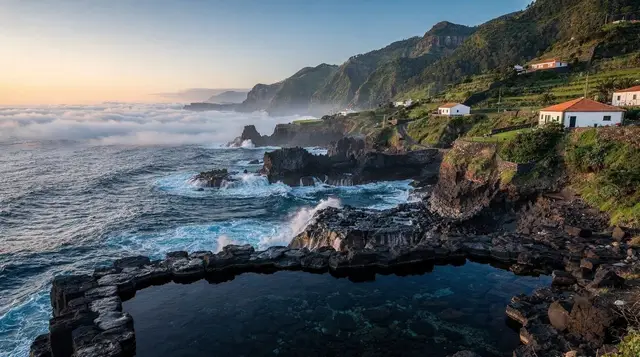
Ponta Delgada’s parish church, rebuilt after fire in the twentieth century, sits close to the sea with a small square in front of it — a good spot to stretch your legs and look back along the coastline you’ve just driven. A little further west, Boaventura’s own church and its cluster of houses climb a gentler slope away from the cliff edge, with banana plantations filling the terraces below. Between the two, short stretches of the old coast road drop close enough to the water that you can watch Atlantic swell break against black rock without leaving the car park.
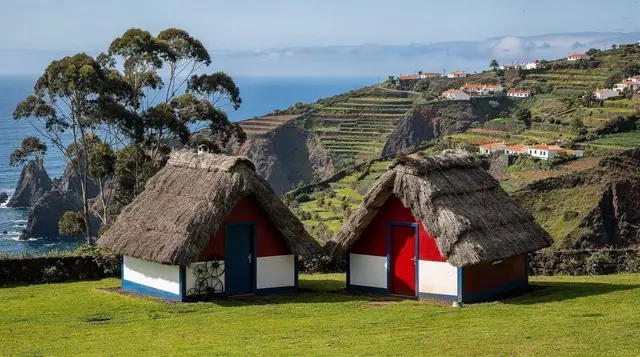
None of this rivals the sights either side. Santana’s thatched houses are a genuine curiosity you won’t see anywhere else on the island; Porto Moniz’s natural pools are a proper swim stop. Boaventura and Ponta Delgada don’t try to compete with either. What they offer instead is a change of pace — a few minutes where the north coast is simply quiet, which after a morning of car parks and photo queues is its own small relief.
The road itself is part of the point
The ER101 through this stretch has been improved over the years, but it still does what north coast roads in Madeira do: it hugs cliffs, ducks through short tunnels, and opens onto sudden sea views with no warning. Between Boaventura and neighbouring Arco de São Jorge, the road climbs and dips along terraced hillsides that are worth slowing down for even if you don’t stop the car.
If you’re driving yourself — and on this stretch of coast, a hire car is genuinely the only practical way to see it — this section is a reminder that on Madeira’s north coast, the drive is frequently the attraction, not a means of getting to one. Our broader notes on driving in Madeira cover the narrow lanes and steep gradients you’ll meet along the way; nothing here is more demanding than what you’ll already have handled getting to Santana.
Why this isn’t a destination in its own right
It’s worth saying plainly, because guides that oversell quiet villages do their readers a disservice: Boaventura is not worth a dedicated trip from Funchal. There’s no levada walk starting here, no museum, no beach, no single photograph that people travel across the island for. What there is, is a pleasant few minutes of coastline on a road you’re likely driving anyway if you’re doing a proper loop of the north.
Treat it as a waypoint. Treat Santana with its casas de colmo, São Vicente’s lava tubes and Porto Moniz as the reasons for the day, and let Boaventura and Ponta Delgada be the quiet bit in between where you don’t feel obliged to do anything at all.
That framing matters for planning as much as expectations. If you’re short on time and have to choose between a longer stop here and more time at Santana or Porto Moniz’s pools, choose the better-known stops every time. Boaventura rewards travellers who already have a full north coast day planned and simply don’t mind pulling over for ten minutes along the way — not travellers looking for an alternative to the busier sights.
Folding it into a longer north coast route
The natural way to see Boaventura and Ponta Delgada is as two stops on a wider loop, and the north coast lends itself well to that kind of day. A typical route from Funchal runs up and over the central mountains or around via Ribeiro Frio, reaches Santana for the thatched houses, continues west through Boaventura and Ponta Delgada, and finishes at São Vicente or Porto Moniz for a swim in the natural pools before heading back along the faster coastal expressway.
Our north Madeira day trip guide lays out a version of that route in more detail, and it’s also one of the stops covered across a longer stay in our one-week Madeira itinerary.
If you’d rather not drive the whole loop yourself, small-group 4x4 tours cover much of this same ground with a driver who knows exactly where to stop. An itinerary that works the coast road out towards Porto Moniz typically passes close to both villages, and a broader private tour covering the whole north-east coast can be built to include a stop in Boaventura specifically if you ask. Both save you the concentration the ER101 demands and let you actually look at the scenery instead of the road.
Waterfalls and forest, a short detour inland
The hills directly behind Boaventura and Ponta Delgada climb quickly towards Madeira’s central laurel forest, and the area is a starting point for some of the guided river and waterfall walks that don’t get the footfall of the Rabaçal classics. If you want to add a proper walk to what would otherwise be a driving day, a guided river hike to one of the north coast’s less visited waterfalls is a reasonable way to turn a Boaventura stop into a half-day out, with a local guide handling the route-finding that these unmarked paths require.
It’s a better use of time than lingering in the villages themselves, and it fits naturally either side of a stop here. For general orientation to the region’s laurel forest, our Laurissilva guide and the wider north coast day trip notes are useful background before you go.
Eating, timing and what to expect
Neither village runs to more than a café or two, so this isn’t a lunch stop in its own right — plan to eat in Santana, São Vicente or Porto Moniz, all of which have proper restaurants serving the usual espetada and bolo do caco. What you can reliably find in Boaventura is a coffee and a pastry if you need to break up the drive, and a public bench or two with a sea view that beats most paid miradouros on the island for the price of nothing.
Timing-wise, there’s no wrong time of day to pass through. Morning light tends to favour the cliffs looking east towards Santana; late afternoon does the opposite. The one thing worth checking before you set off is the weather on the north coast specifically, since it runs noticeably wetter and cloudier than Funchal and the south — a clear morning in town is no guarantee of a clear afternoon here. If low cloud has settled over the north coast, the sea views that are the whole point of stopping simply won’t be there, and you’re better off pushing on to an indoor stop like the lava caves at São Vicente instead.
There’s no fee to stop in either village and nothing to book in advance — this is a free, unstructured pause, not a managed attraction. The only cost involved is the fuel and time it takes to include it in your loop, which is exactly why it belongs on a longer itinerary rather than as a reason to leave Funchal in the first place.
Dressing and packing for a short north coast stop
Because the stop is brief, it is easy to under-prepare. The north coast is exposed to the wind and the sea spray, and a clear sky at the Funchal end of the drive can turn into cloud and a cool breeze by the time you reach the cliffs. A light waterproof layer and shoes with some grip cost nothing to carry and make the difference between enjoying ten minutes at the viewpoint and hurrying back to the car. Our notes on what to pack for Madeira and on mountain weather and what to wear apply just as well to the coast road as they do to the peaks, since the island’s weather changes quickly over short distances.
A camera or a phone with a charged battery is the other thing worth having to hand. The light on the cliffs is the main reason to pull over, and our photography spots in Madeira guide and the list of viewpoints and miradouros will help you decide where else on the same day deserves a longer pause.
Where Boaventura fits among the other north coast stops
It helps to think of the north coast as a string of very different places, each with its own job in the day. Faial and Porto da Cruz lie to the east, Santana gives you the postcard houses, and São Jorge and the Arco de São Jorge sit close to the quiet pair described here. Further west come São Vicente, Seixal and Porto Moniz, where the island turns to lava pools and rough water. Boaventura and Ponta Delgada are the breathing space in the middle of that sequence, and a day that includes them tends to feel less rushed than one that goes straight from one headline stop to the next.
If you are still choosing between the two sides of the island, our comparison of north versus south Madeira explains why the north feels so different from the sunny south coast, and the east versus west jeep tour guide shows how organised tours divide the same ground. For a wider view of how guided and self-drive days compare, read guided tour versus self-drive before you commit.
Making the stop part of a wider trip
If your time on the island is short, Boaventura is best treated as a bonus rather than a goal. A three-day plan or a five-day plan can fit a north coast loop comfortably, and the quiet villages then become a natural place to stop for a coffee between the bigger sights. On a longer stay, a week in Madeira leaves room to do the loop slowly, in decent weather, without watching the clock.
Travellers who would rather not drive can still reach this stretch of coast. Our guide to getting around without a car and the itinerary for Madeira without a car set out the realistic options, and an organised 4x4 day is usually the simplest way to include the coast road. The notes on 4x4 jeep tours explained describe what to expect from one. For a first visit to the island more generally, start with first time in Madeira, and if rain is forecast on the north coast, a rainy day plan for Madeira offers alternatives that do not depend on a view.
Boaventura and Ponta Delgada: your questions answered
Are Boaventura and Ponta Delgada worth a special trip from Funchal?
No. Neither village has a single attraction that justifies the fifty-minute drive on its own. They’re worth a short stop as part of a longer north coast loop that also includes Santana, São Vicente or Porto Moniz — not a destination to plan a whole day around.
How much time should I spend in Boaventura?
An hour at most, and often closer to fifteen or twenty minutes. There isn’t enough here to fill a longer visit, and that time is better spent at the more substantial stops nearby.
Is there an entrance fee or anything to book?
No. Both villages are open, unmanaged stops on a public road — you simply pull over, look around and continue. There’s nothing to reserve in advance.
What’s the difference between Boaventura and Santana’s thatched houses?
They’re different stops on the same road. Santana has the famous triangular casas de colmo and draws the crowds; Boaventura, a short drive further west, has none of that but offers a quieter stretch of coastline in between. See our guide to Santana’s thatched houses for that separate stop.
Can I swim near Boaventura?
Not really — there are no managed natural pools in either village. For a proper swim on this stretch of coast, continue to Porto Moniz’s natural pools or backtrack slightly to Seixal’s natural pools, both a short drive away.
Do I need a car to visit Boaventura and Ponta Delgada?
Effectively yes. Public buses run along parts of the north coast but with limited frequency and timing that makes a quick roadside stop impractical. A hire car, or a guided 4x4 tour that already routes through the area, is the realistic way to see either village.
What’s the weather like compared to Funchal?
Wetter and cloudier, most of the year. The north coast sits on the windward, rain-catching side of the island, and low cloud here doesn’t necessarily mean bad weather in Funchal, or the other way round. Check conditions for the north coast specifically before you set off.
Is there anywhere to eat in Boaventura?
Only small cafés, not full restaurants. Plan your lunch stop for Santana, São Vicente or Porto Moniz, all of which are close by and better equipped for a proper meal.