Madeira's Vineyards and the Festa do Vinho
Where can you visit vineyards in Madeira, and when is the wine festival?
The most visitable vineyards cluster on the terraced slopes above Estreito de Câmara de Lobos, reached on organised half-day tours or 4x4 trips. The Festa do Vinho, Madeira's harvest wine festival, runs in late August or early September, mainly around Câmara de Lobos and Funchal, with folk dancing, grape treading and open cellars.
Terraced vines above the Atlantic
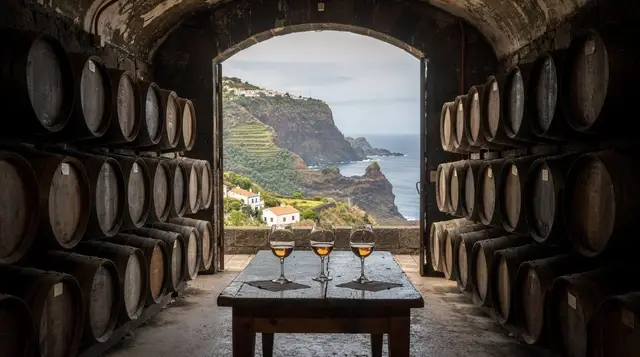
Most visitors to Madeira meet the island’s wine in a cellar in central Funchal, tasting a glass at Blandy’s Wine Lodge without ever seeing a single vine. That’s a fair introduction, and if all you want is the history and a flight of Sercial through Malvasia, our separate guide to Madeira wine tastings in Funchal covers it properly.
This page is about the other half of the picture: the vineyards themselves, mostly strung along steep terraces above Câmara de Lobos and Estreito de Câmara de Lobos, and the one week of the year when the whole west coast turns the harvest into a festival.
Madeira has no flat land to speak of, so its vineyards were never going to look like the ordered rows of a mainland estate. Growers cut narrow terraces, called poios, into the hillside and trained vines high overhead on pergola-style trellises known as latadas, both to save precious ground for vegetables underneath and to keep the grapes clear of damp, disease-prone air near the soil.
The result, seen from a viewpoint above Estreito de Câmara de Lobos, is a green lattice draped across the slope rather than a vineyard in the conventional sense, and it’s this landscape, not a wine list, that makes a visit worth the drive. For the wine itself, its four noble grapes and the fortifying process that gives it decades of shelf life, see our companion guide to how Madeira wine is made rather than have it repeated here.
Visiting the vineyards around Estreito de Câmara de Lobos
Estreito de Câmara de Lobos, the inland parish above the fishing town where Winston Churchill once painted, sits at the centre of Madeira’s remaining wine country. It’s a working agricultural area rather than a tourist set piece, which is exactly its appeal: narrow lanes wind between plots still farmed by families who have held the same terraces for generations, and a handful of them open their cellars to visitors, usually as part of an organised tour rather than a casual walk-in.
What you’ll actually see growing is mostly Tinta Negra, the workhorse variety that accounts for the great majority of Madeira’s harvest and rarely gets individual billing on a wine list. The four noble grapes that Madeira wine is famous for, Sercial, Verdelho, Boal and Malvasia, are planted in much smaller, scattered pockets, and a good guide will point them out specifically rather than assume you’ll recognise them. Vines share the terraces with bananas, passion fruit and vegetable plots, a reminder that this was subsistence farming long before it was a tourist attraction.
A few practical notes if you’re planning to go independently rather than on a tour:
| What to expect | Detail |
|---|---|
| Access | Narrow, steep lanes; a small hire car works better than a large one |
| Opening | Most quintas visit by appointment or through a tour operator, not walk-in |
| Best season to see activity | Harvest, roughly late August into September |
| Combine with | Cabo Girão skywalk, Câmara de Lobos old town, poncha bars |
| Language | Guided tours in English are standard; solo visits may be Portuguese-only |
Because the quintas here are small and family-run, independent visits are hit and miss without a booking, and September in particular can see them prioritising the harvest over hosting guests. A half-day tour that bundles the vineyard visit with a tasting and transport solves both problems at once.
What a vineyard tour actually involves
A typical half-day trip collects you in Funchal, drives the short but winding route up to Câmara de Lobos and Estreito de Câmara de Lobos, and stops at one or more small producers along the way. Expect a walk through the terraces with a guide explaining the latada trellis system and why the volcanic, well-drained soil suits the vines, followed by a tasting back at the quinta or lodge, usually of both the fortified Madeira style and, increasingly, the still table wines some producers now make alongside it. If you’d rather see the coastline as well as the vines, several tours pair the vineyard stop with the Cabo Girão skywalk a short drive further along the coast.
This half-day tour with Madeira wine tasting is the most straightforward way to see the vineyards and taste the result on the same trip, without hiring a car or working out bus connections into the hills.
For a version that adds Cabo Girão’s glass-floor skywalk to the same outing, this Funchal tour combining Cabo Girão and wine tasting in Câmara de Lobos covers both in one afternoon.
Families or anyone wanting a gentler pace sometimes prefer this tour pairing the Boca dos Namorados bird park with Cabo Girão and a wine stop, which breaks the vineyard visit up with something for children.
If you’d rather go deeper than a coach-tour stop, this private 4x4 expedition into Madeira’s vineyards and wine culture spends more time on the terraces themselves and can be tailored around the harvest if you’re visiting in late August or September.
None of these need to be booked weeks ahead outside the festival period, but during the Festa do Vinho itself, when small producers are juggling visitors and the actual harvest, book a few days out rather than assuming a same-day slot.
The Festa do Vinho: Madeira’s harvest wine festival
The Festa do Vinho is Madeira’s answer to a grape harvest festival, held in the last week of August or the first week of September depending on how the season has run. Because it’s tied to the harvest rather than a fixed calendar date, the exact dates move slightly from year to year; check the current year’s schedule before you build a trip around it rather than assuming last year’s dates.
The festival centres on Câmara de Lobos and Estreito de Câmara de Lobos, the same area covered above, with a smaller programme of events in Funchal itself. Expect open-air folk performances in traditional costume, grape treading demonstrations where visitors can join in barefoot in a wooden lagar, stalls selling wine, poncha and local food, and open cellars at some of the smaller quintas that don’t normally receive visitors outside this week. It’s a working agricultural festival rather than a polished tourist show, closer in spirit to a village harvest fair than to Funchal’s big set-piece events, and that’s a large part of its appeal if you happen to be on the island at the right time.
If you’re weighing up whether it’s worth timing a trip around, our companion piece on what changed when the levadas started charging and other honest, on-the-ground write-ups in our blog section are a useful gut check on Madeira beyond the marketing copy; the festival itself is genuinely low-key rather than a headline event, which is either the appeal or the disappointment depending on what you’re expecting.
What happens, day by day
The Festa do Vinho typically unfolds as a loose sequence rather than a single ticketed event:
- Opening ceremony, usually in Câmara de Lobos, with folk groups in regional dress and a formal blessing of the harvest.
- Grape treading, staged at one or more quintas, where visitors can step into the lagar alongside local pickers, feet and all.
- Open cellars and tastings at small producers around Estreito de Câmara de Lobos who don’t normally host casual visitors.
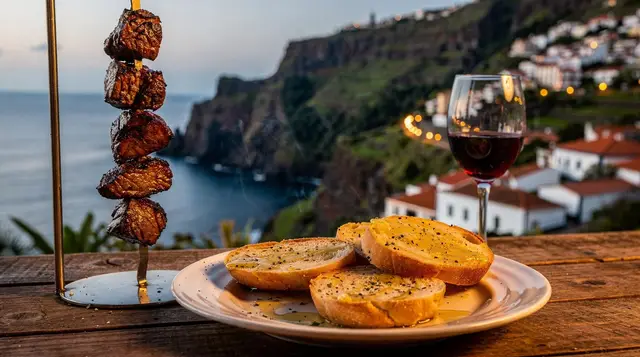
- Food and wine stalls through the town, with espetada, bolo do caco and poncha alongside the festival’s own wine.
- Evening folk performances, ranchos folclóricos in traditional costume performing harvest songs and dances.
None of this requires advance tickets in the way a concert would; it’s a public, town-wide event you can wander into. The exception is any organised vineyard tour running that week, which should be booked ahead as covered above.
How to take part
You don’t need a reason beyond curiosity to attend; the festival happens in public spaces in Câmara de Lobos and Estreito de Câmara de Lobos, and turning up is enough. A few things make it easier:
- Base yourself for easy access. Câmara de Lobos and Funchal both work; Funchal gives you more accommodation choice, with a short drive or bus ride out for festival days. See our guide to driving in Madeira or car rental if you’re weighing up a hire car for the week.
- Bring cash for stalls. Small vendors selling food, wine and poncha at a village-level event don’t all take cards.
- Wear shoes you don’t mind getting stained if you plan to join the grape treading; the juice marks well.
- Check the current year’s exact dates before booking flights or accommodation around it, since the harvest timing shifts the festival by up to a week or two either way.
- Pair it with a proper vineyard visit on one of the tours above, ideally earlier in the week before the festival crowds pick up, so you get the quieter version of the terraces as well as the festive one.
If you’re building a longer trip and want wine and food as the theme rather than a single festival day, our food and wine weekend itinerary sequences vineyard visits, tastings and Câmara de Lobos into a fuller weekend.
Don’t confuse it with Madeira’s other festivals
Madeira runs a busy annual festival calendar, and the Festa do Vinho gets mixed up with two other events often enough that it’s worth being explicit about the difference.
| Festival | Season | What it actually is |
|---|---|---|
| Festa do Vinho | Late August to early September | Harvest wine festival, centred on Câmara de Lobos and Estreito de Câmara de Lobos |
| Festa da Flor | Spring, about two weeks after Easter | Flower festival with a flower-covered parade through Funchal |
| Festival do Atlantico | June | Weekend fireworks competitions over Funchal Bay, plus concerts |
The mix-up usually runs one of two ways: travellers reading about the Festa da Flor’s flower parade assume it involves wine, or they see “wine festival” and picture the pyrotechnics of the Festival do Atlantico. They’re three separate events, in three separate seasons, run for three different reasons, and none of them substitute for another if the one you actually wanted was the harvest festival. If it’s the spring flowers you’re after, our Festa da Flor guide covers that separately, and our wider festival calendar lays out the full year including Carnival and New Year in Funchal so you can see how the Festa do Vinho sits alongside the rest.
Vineyards and Festa do Vinho: your questions answered
When exactly is the Festa do Vinho?
It falls in the last week of August or the first week of September, timed to the harvest rather than a fixed date. Check the current year’s dates before booking, since a late or early crop can shift the festival by a week or so.
Is the Festa do Vinho the same as the Festa da Flor?
No. The Festa da Flor is Madeira’s spring flower festival, held around two weeks after Easter, with a flower parade through Funchal. The Festa do Vinho is a separate, autumn event tied to the grape harvest.
Is the Festa do Vinho the same as the Festival do Atlantico?
No. The Festival do Atlantico is a June event built around weekend fireworks competitions over Funchal Bay. The Festa do Vinho is smaller, later in the year, and centred on wine rather than pyrotechnics.
Can you actually visit a vineyard in Madeira, or only a wine lodge?
Both. Wine lodges in central Funchal, such as Blandy’s, focus on ageing cellars and tastings rather than vines. To see the terraced vineyards themselves, and often to help tread grapes at harvest time, you need a tour out to Estreito de Câmara de Lobos or the wider west coast.
Do you need to book a vineyard tour in advance?
Yes, particularly around the harvest and the Festa do Vinho, when small family-run quintas can only host limited numbers. Half-day and full-day tours that combine vineyard visits with tastings should be booked a few days ahead in September.
What grape varieties will you actually see growing?
Mostly Tinta Negra, which makes up the bulk of the harvest, trained high on pergola-style trellises called latadas. The four noble varieties, Sercial, Verdelho, Boal and Malvasia, grow in smaller, scattered plots and are usually pointed out specifically by a guide rather than obvious to a visitor alone.
Is the Festa do Vinho worth building a trip around?
It suits travellers who already want to be in Madeira in late August or early September for the weather and hiking season, and who enjoy local festivals more than beach time. It is not a reason on its own to skip the quieter, cheaper shoulder months either side.
Food, wine and poncha tours on GetYourGuide
Verified deep-linked GetYourGuide tours. Book through these links and we earn a small commission at no cost to you.
GetYourGuide does not provide a product photo for this activity — the image shows the meeting point, photographed by us.