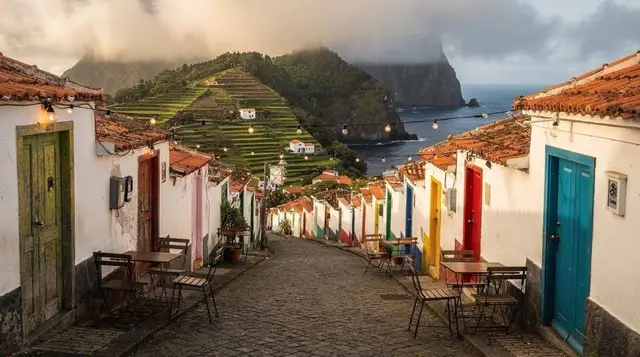
São Martinho sits on the rising ground immediately west of central Funchal, a working residential parish rather than a stop on the tourist trail. Locals commute down into the city each morning; visitors who find their way up here are usually staying nearby, chasing a sunset, or simply tired of the crowds around the Zona Velha. Neither reason is wrong. What São Martinho offers is a view and some quiet, and it’s worth being honest about that from the start: this is not a place with a museum, a market or a marquee attraction to build a day around. It’s a hillside neighbourhood that happens to face west over one of the best stretches of water in the archipelago.
A quarter built on its view, not its sights
Funchal’s old town hugs the seafront in a natural amphitheatre, and the hills rising behind and to either side of it are where the city actually lives. São Martinho is one of those hillside parishes, wedged between the centre and Câmara de Lobos further along the coast. The two get confused by first-time visitors reading a map too quickly, so it’s worth being direct: they are different places in different parts of the island.
Câmara de Lobos is the traditional fishing village where Winston Churchill famously set up his easel; that story, and the harbour it happens in, belong to that page, not this one. São Martinho has no fishing harbour and no painter’s legend. Its interest is simpler — height, aspect, and a west-facing view over Funchal Bay that the lower streets of the city centre don’t get.
Streets here climb steeply from the coast road up through terraces of housing, small gardens, banana plantations tucked between plots, and the occasional miradouro where the ground opens up. There’s no single named viewpoint that dominates the area the way Pico dos Barcelos does a little further along the same hillside, but that’s part of the point: in São Martinho, the view is diffuse, available from several streets and corners rather than concentrated at one ticketed spot.
Why the sunset is the actual draw
Funchal Bay faces roughly south, but the western suburbs, São Martinho included, catch the evening light as the sun drops toward the Atlantic beyond Cabo Girão and the western coastline. From a good vantage point here, on a clear evening, the whole bay lays out below: the cruise ships at anchor off the Funchal Marina, the lights coming on along the Lido Promenade, and further round, the cliffs that eventually give way to Câmara de Lobos and the west. It’s a wide, unhurried view, and it’s the one genuine reason to come up here rather than stay down at sea level.
This matters for planning: São Martinho rewards a specific hour of the day and doesn’t reward the rest of it equally. Arrive at midday in August and you’ll find a pleasant, ordinary residential neighbourhood in flat, hazy light with little to hold your attention. Arrive an hour before sunset and the same streets earn the detour. If sunset views are genuinely the goal, it’s also worth weighing São Martinho against doing it from the water instead — a cruise along the southern coast at golden hour gives a moving vantage point over the same stretch of coastline, cliffs and bay included, which some travellers find more memorable than a fixed street-corner view.
The parish church and the everyday texture of the place
The Igreja de São Martinho, the parish church that gives the area its name, sits at the heart of the neighbourhood and functions exactly as a parish church should: it’s the anchor of a real community, with regular services and local life built around it, not a stop on a sightseeing itinerary. It’s a pleasant, modest building, worth a glance if you’re passing, but it isn’t the reason to make the trip and shouldn’t be oversold as one.
The same goes for the quarter generally — there’s no equivalent here to the Mercado dos Lavradores or the painted doors of the Zona Velha. What there is instead is ordinary Madeiran suburban life: small grocers, a café or two doing brisk trade with regulars rather than tourists, allotments squeezed onto terraces too steep for anything grander, washing lines strung between balconies with the bay glinting below them. If that texture appeals to you more than another queue, São Martinho delivers it honestly.
Why it feels calmer than the centre
Central Funchal, particularly the Zona Velha and the streets around Rua de Santa Maria, can be genuinely crowded in high season — restaurant touts, cruise-ship day-trippers, and traffic converging on a compact old town built for a much smaller city. São Martinho doesn’t have any of that pressure, simply because there’s nothing here that draws a crowd.
The upside is real: quieter streets, easier parking, and a sense of the island as somewhere people actually live rather than a stage set for visitors. The downside is equally real: fewer restaurants, no real nightlife, and nothing within easy walking distance once the sun goes down beyond a local café or two. It suits a certain kind of traveller — generally one who has already spent a day or two in the old town and now wants a base, or an evening, that isn’t built around tourism at all.
Getting there and getting around
A car is the easiest way to reach São Martinho and by far the best way to explore its side streets, since the interesting corners are scattered across a hillside rather than laid out on one walkable route. The drive up from the seafront takes ten to fifteen minutes depending on where in the centre you start and how the traffic on the coast road is running. Taxis and rideshare apps cover the same ground without the parking question, which matters here more than it does lower down — streets are narrow, gradients are steep, and casual on-street parking is tighter than in the flatter parts of the city.
| Option | Time from centre | Notes |
|---|---|---|
| Self-drive | 10-15 minutes | Best for reaching specific viewpoints; parking is tight on some streets |
| Taxi / rideshare | 10-15 minutes | Simplest option if you don’t want to deal with parking |
| Local bus | 20-30 minutes | Runs on residents’ timetables, not a sightseeing service |
| On foot from the old town | 45-60 minutes uphill | Steep and only for those who enjoy a climbing walk |
If you don’t have a car for the rest of your stay, it’s worth reading up on getting around Madeira without one before committing to São Martinho as a base, since the neighbourhood’s appeal depends partly on being able to move around it freely. Travellers who do plan to self-drive for the wider island should also look at car rental in Madeira, since a small car makes a real difference on gradients like these.
What São Martinho is not
It’s worth being blunt about the things this page deliberately doesn’t cover, because the confusion is common. This is not the fishing village of Câmara de Lobos, which lies further west along the coast and has its own history, harbour, and Churchill connection — that’s covered on its own page.
It is also not a hiking destination: the dramatic east-coast trail out to Ponta de São Lourenço is a completely different part of the island, reached from Canical rather than from here. And it’s not a beach resort — Funchal’s own coastline near São Martinho is mostly rocky shoreline and private hotel access rather than open sand. Travellers looking for any of those things should follow the links above rather than expect to find them on this hillside.
What São Martinho genuinely is: a residential quarter with a view, useful as a quiet corner of a Funchal stay or as somewhere to catch sunset on a evening when the old town feels like too much effort. Setting expectations at that level is the honest way to plan around it.
Where to stay and eat nearby
Accommodation in and immediately around São Martinho tends toward apartments and smaller aparthotels rather than the big resort properties clustered along the Lido and the hotel zone closer to the centre. That suits self-caterers and longer stays better than a short city break, since restaurant options thin out once you’re off the main coast road.
For dinner, most visitors staying up here drive or taxi back down into central Funchal, where the choice is far wider — see where to eat by area for a rundown organised roughly by neighbourhood. If you’re still deciding where to base yourself for a Madeira trip generally, the broader guide to where to stay in Madeira is the better starting point than this page alone.
Making the most of a stay near the western suburbs
Because São Martinho itself doesn’t fill a day, most visitors treat it as a base or a late-afternoon stop rather than a destination in its own right, using it as a quiet launch point for excursions elsewhere on the island. Several of the island’s best-known trips depart from central Funchal, close enough to São Martinho that pickup from this side of the city is often included.
An early sunrise jeep tour to Pico do Arieiro typically collects guests from Funchal hotels before dawn, which makes a São Martinho base only a few minutes further for the driver than the city centre. Travellers drawn more to valleys and viewpoints than mountain summits might prefer a jeep tour through the valleys and viewpoints toward São Cristóvão, again with hotel pickup covering this part of the city.
For those who’d rather see the coastline from the water than from a hillside street, a few options run from Funchal’s marina, a short drive down from São Martinho. A private catamaran tour toward Ponta de São Lourenço covers the dramatic eastern tip of the island by boat, while travellers heading further east by land can arrange a transfer from Funchal to Caniçal for the PR8 hike out along that same peninsula. None of these trips actually pass through São Martinho itself, but staying in this quieter corner of the city doesn’t put any of them meaningfully out of reach — it’s still Funchal, just a few streets higher up the hill.
A realistic plan for visiting
Treat São Martinho as an add-on rather than an anchor. If you’re staying elsewhere in Funchal, drive or taxi up in the last hour or two before sunset, walk a few of the residential streets near a viewpoint, watch the light change over the bay, then head back down for dinner in the centre. If you’re staying in the area itself, use the quiet and the parking as the advantage they are, and plan to travel into town for restaurants, shopping and evening life. Either way, keep expectations calibrated: this is a neighbourhood, not an attraction, and it does one thing — a view over the bay — genuinely well.
São Martinho and Funchal’s western suburbs: your questions answered
What is São Martinho and is it worth visiting?
São Martinho is a residential parish on the hillside directly west of central Funchal, best known for wide sunset views over the bay rather than any single sight. It suits a quiet late afternoon, not a full day out.
Is São Martinho the same place as Câmara de Lobos?
No. São Martinho is a Funchal suburb a short drive from the city centre. Câmara de Lobos is a separate fishing village further west, famous for the spot where Winston Churchill painted, and it has its own page on this site.
How do I get to São Martinho from central Funchal?
By car it’s roughly 10-15 minutes via the VR1 or the older coast road, depending on traffic. Taxis and rideshare are straightforward. Local buses run through the area but are built for residents’ timetables, not sightseeing, so a car or taxi suits visitors better.
What is there to actually do in São Martinho?
Walk the residential streets and miradouros for sea views, visit the small parish church of São Martinho, and stop at a local café rather than a tourist restaurant. It’s a place to slow down for an hour or two, not a checklist of attractions.
Is São Martinho a good place to stay?
It can suit self-drivers who want quieter streets, easier parking and sea views, and don’t mind a short drive into the old town each day. It’s less convenient for visitors without a car who want to walk everywhere.
Is São Martinho safe to walk around in the evening?
Yes, it’s an ordinary residential neighbourhood with no particular safety concerns, though street lighting is more modest than in central Funchal and pavements can be narrow and steep in places.
What’s the best time of day to visit?
Late afternoon into sunset. The wide western aspect over the bay is the area’s real appeal, and it’s largely lost in flat midday light or after dark.