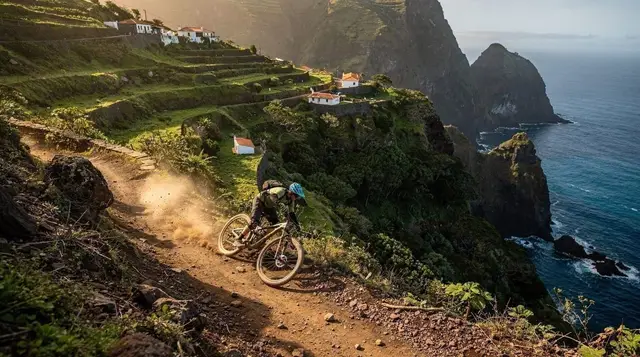
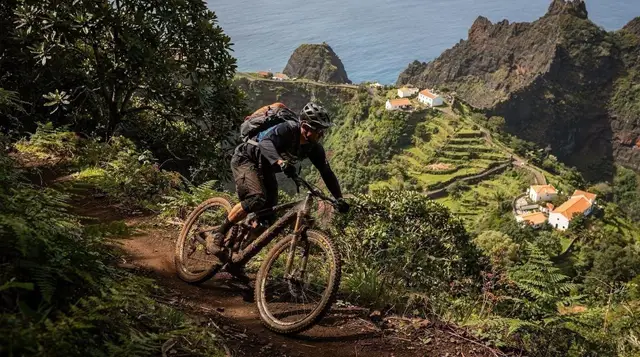
E-Bike Tours in Madeira: Camacha's Gentler Route to the Hills
Are e-bike tours in Madeira suitable for beginners?
Yes. E-bike tours, most of them run out of Camacha, use pedal-assisted road and gravel bikes rather than technical mountain bikes, so a reasonable level of fitness and basic road cycling confidence is enough. The motor removes most of the climbing effort, but Madeira's gradients are steep enough that riders still work, and descents on narrow mountain roads require real concentration.
Why an e-bike solves Madeira’s biggest cycling problem
Madeira’s terrain is the reason most visitors never consider cycling here at all. The island climbs from sea level to over 1,800 metres in a horizontal distance of a few kilometres, and its roads follow that geography honestly: switchbacks, sustained gradients, and stretches steep enough to stop an unassisted rider on a loaded bike within the first hour. A traditional mountain biking tour asks a lot of a visitor’s legs before it asks anything of their nerve.
An e-bike tour changes that equation without pretending the island has gone flat. The motor takes over most of the climbing, so a rider who would never attempt Madeira’s hills on a normal bike can follow a route that includes several hundred metres of ascent and still have something left for the descent. What the motor does not remove is the steepness itself: pedal-assist flattens the effort curve, it does not flatten the road. Riders who arrive expecting a scooter with pedals are usually surprised by how much they still notice the gradient, particularly on the sections between villages where the assist tapers off at the higher speed limits built into most rental bikes.
This is the gap e-bike tours are built to fill: more physically accessible than Madeira’s mountain biking scene, more active and more scenic than sitting in a jeep or a minibus. It suits a wider range of ages and fitness levels than almost any other way of covering ground in the hills, which is precisely why it has grown into its own category of tour rather than a footnote on the mountain biking page.
Camacha as the starting point
Camacha sits roughly 700 metres above Funchal, a fifteen-minute drive inland and uphill from the capital, and it has become the effective base for e-bike tourism on the island for a simple reason: altitude already banked. Most operators collect guests by transfer or minibus, load the bikes, and start the ride from Camacha’s own elevation rather than from sea level, which means the first hour of most tours is descent or rolling terrain rather than a slog uphill through traffic.
From Camacha, routes fan out in a few directions. Roads run north-east towards Porto da Cruz and the Portela pass, opening views over the north coast that most Funchal-based visitors never see. Others head towards Santo da Serra and the plateau behind it, or drop east towards the coast near Machico. The common thread is that nearly every route uses Camacha’s elevation as a springboard, turning what would otherwise be an exhausting climb into the warm-up, not the whole ride.
The village itself is worth a few minutes beyond the bike shop. Camacha is known across the island as the historic centre of Madeira’s wickerwork trade, with workshops still weaving willow into furniture and baskets in the same techniques used for well over a century, and its central bandstand and square give tours a natural, unhurried meeting point before setting off.
What a Madeira e-bike tour actually involves
Two formats dominate the current offering, and it is worth understanding the difference before booking, because they suit different travellers.
Self-guided tours hand over a bike, a route loaded onto a GPS device or phone app, and a support contact, then let riders set their own pace. A self-guided e-bike route from Camacha to Monte typically includes a lunch stop and finishes with a straightforward drop into the Funchal area, giving confident but independent riders control over how long they linger at viewpoints. These suit visitors who are comfortable navigating from a screen and prefer not to be tied to a group’s pace.
Guided tours keep a leader at the front, handle navigation, and generally include more storytelling about the villages and terrain passed along the way. A guided e-bike tour to Portela and Faja dos Rolos is a good example: a small group format that reaches a remote coastal terrace most rental-car visitors would never find on their own, with the guide managing pacing so nobody is left working harder than they expected.
A third variant worth knowing about follows Madeira’s historic irrigation network on wheels rather than on foot. The Levada da Serra e-bike tour uses the wide service track alongside one of the island’s oldest channels, a gentler surface than the paved mountain roads and a useful option for riders who want scenery without steep tarmac switchbacks.
Most tours run for half a day, between three and five hours including stops, with a small number of full-day itineraries for stronger riders wanting to cover more distance. Group sizes tend to stay small, usually under ten, which keeps the pace flexible and makes it easier for a guide to notice when someone is struggling.
Fitness and skill level, honestly
This is the point most worth getting right before booking, because the gap between “assisted” and “effortless” causes more disappointment on Madeira’s e-bike tours than almost any other single factor.
| Factor | Traditional mountain biking | E-bike touring |
|---|---|---|
| Typical surface | Technical single-track, loose ground | Paved roads, graded tracks |
| Climbing effort | High, unassisted | Reduced, but still noticeable on steep sections |
| Off-road bike-handling skill | Required | Not required |
| Typical group | Experienced or sporty cyclists | Broad range of ages and fitness |
| Realistic minimum age | Teens and up, skill-dependent | Often accessible to keen younger teens with a guide’s approval |
| A day’s effort, honestly | Demanding | Moderate, still tiring by afternoon |
The motor assist on Madeira’s rental e-bikes typically cuts out around 25 km/h, which matters on the island’s steepest pitches: riders climbing a genuinely severe gradient will still be pedalling hard even with full assistance, because the bike’s own speed limiter, not the battery, becomes the constraint. Descents bring a different kind of effort. Madeira’s mountain roads drop fast, surfaces can be damp or uneven, and braking discipline on long descents uses forearm and grip strength that catches out riders who assumed the hard part was over once the climbing stopped.
None of this puts e-bike touring out of reach for an averagely fit adult. It does mean treating it as a genuine activity rather than a passive ride, arriving with a proper night’s sleep, and not scheduling a demanding hike the same afternoon.
Choosing a route
| Route type | Starting point | Terrain | Best for |
|---|---|---|---|
| Camacha to Monte | Camacha | Road, descent-heavy | First-time e-bikers, self-guided pace |
| Portela and Faja dos Rolos | Camacha | Road and coastal track | Guided groups, remote north-east scenery |
| Levada da Serra | Camacha, with transfer | Wide levada track | Riders who prefer gentler surfaces |
| Ponta de São Lourenço direction | East Madeira | Road, exposed terrain | Confident self-guided riders wanting coastal scenery |
A self-guided road e-bike route towards Ponta de São Lourenço takes riders east instead of north, tracing roads towards the volcanic peninsula covered in its own guide, though the wind and lack of shade out there make it a route best started early in the day.
Riders weighing up an e-bike tour against a jeep-based sightseeing day, or wondering whether to combine the two across a longer stay, will find the ground-level comparison covered in the east Madeira day trip guide, which lays out how much of this same territory can be covered by road instead.
Booking practicalities
Bikes, helmets, and a basic safety briefing are included as standard; what varies between operators is transfer arrangements, lunch inclusion, and whether the format is guided or self-guided. Self-guided tours generally cost less and offer more flexibility on timing, while guided tours cost more but remove the navigation burden and add local commentary, which matters more on routes through villages with no signposted history than on a simple out-and-back.
Trail fees are not part of this equation. The permit system introduced on official levada walking trails in August 2021 applies to walkers on the PR-numbered paths, not to cyclists on paved or graded roads, so e-bike tour pricing reflects the operator’s own rate rather than any government fee layered on top.
Anyone planning to hire a car separately for the rest of their trip should read the car rental in Madeira guide before deciding how much driving to add around an e-bike day; Madeira’s roads reward a small car and caution regardless of how the visitor is getting around on any given day.
What to bring and what to expect on the day
Camacha’s altitude means the temperature at the start of a tour can be five degrees or more below Funchal’s seafront reading, and mist is common in the early morning even when the coast is clear. A light waterproof layer, closed shoes rather than sandals, and gloves are worth packing regardless of season; sunglasses matter too, since descents move fast enough to catch grit and insects. Operators supply helmets and expect them worn without exception.
Water and a snack are usually provided or available at a stop, but bringing a small amount of cash for anything extra along the route, such as a coffee in a village bar, is sensible since not every stop takes cards. Anyone concerned about the weather more broadly, rather than just on the day, will find seasonal patterns laid out in the best time to visit Madeira guide and the fuller breakdown of mountain weather and what to wear, both useful before packing for a stay that mixes coastal days with time up at Camacha’s elevation.
Riders who prefer their sightseeing without pedalling at all, but still want to cover similar ground around Funchal’s outskirts, can compare notes with the 4x4 jeep tours explained guide; a few operators, including the team behind the 4x4 city and hills tour from Funchal, run both formats and can advise which suits a given group better.
Who an e-bike tour is not for
It is worth being direct about the limits. Riders with no cycling experience at all, who struggle to balance a bike on a flat surface, will not gain enough from the motor to make Madeira’s descents comfortable, since braking and steering on a loaded e-bike through switchbacks still demands basic control. Anyone with a knee, back, or heart condition that makes sustained physical activity inadvisable should check with a doctor first, motor or not. And travellers hoping for a genuinely gentle, low-effort outing are better served by a levada walk on flat ground or a scenic drive than by any bike tour, e-assisted or otherwise.
For everyone else, an e-bike tour out of Camacha remains one of the more efficient ways to see a slice of Madeira’s interior that most short visits never reach: a half-day that trades a mountain biker’s fitness requirement for an ordinary adult’s stamina, without pretending the island’s gradients have gone anywhere.
Cycling and e-bike tours on GetYourGuide
Verified deep-linked GetYourGuide tours. Book through these links and we earn a small commission at no cost to you.
GetYourGuide does not provide a product photo for this activity — the image shows the meeting point, photographed by us.