Mountain Biking in Madeira: Paul da Serra and the Coastal Descents
Where do you go mountain biking in Madeira?
Most rides start on the Paul da Serra plateau at around 1,400m, then drop through forest and terraced farmland to the north or south coast. Bikes and guiding are widely available out of Funchal; independent riding needs real off-road experience because of the terrain and the weather on the plateau.
Riding Madeira’s high plateau and its coastal drops
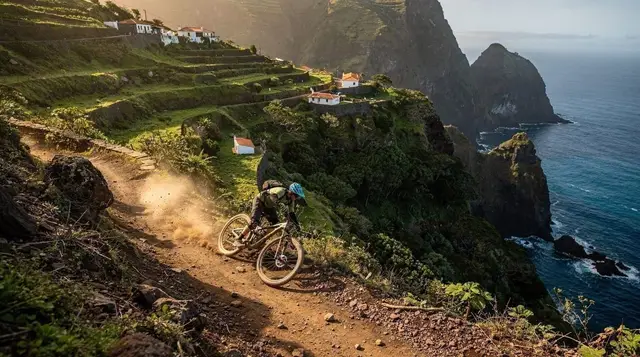
Madeira is not an obvious mountain bike destination the way, say, the Alps or the Pyrenees are. There is no lift-served bike park, no network of purpose-built singletrack, and no village entirely geared around two wheels. What the island does have is a genuinely unusual geography for riding: a flat volcanic plateau sitting at around 1,400m, ringed by some of the steepest inhabited terrain in Europe, laced with old farm tracks and disused irrigation paths that drop thousands of metres to the sea in a handful of kilometres. Put a mountain bike on that plateau and point it downhill, and you get descents that few other places in Europe can match for scenery per pedal stroke.
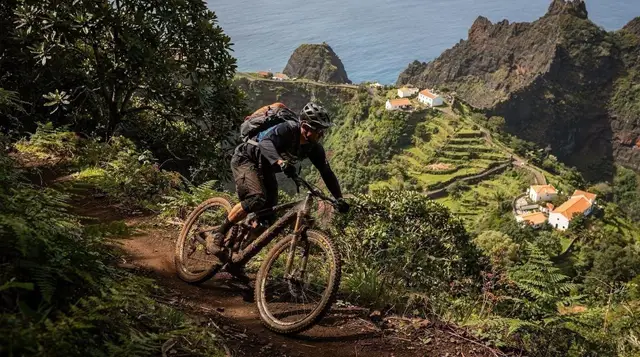
The heart of it is the Paul da Serra, the only real plateau on an island otherwise defined by ridgelines and valleys. From there, riders drop north towards Porto Moniz and Seixal, or west and south towards Prazeres and Calheta, passing through laurel forest, eucalyptus plantations, terraced smallholdings and small villages that most visitors never see from a car. This guide covers what that riding actually involves: the plateau itself, hiring a bike, typical routes, who this suits, and the gear and weather realities that guidebooks tend to skip over.
Paul da Serra: the plateau that isn’t as easy as it looks
Every write-up of the Paul da Serra mentions that it is flat, and every one of them is right — by Madeiran standards, at least. Compared with the hairpins and 20%-plus gradients found almost everywhere else on the island, a plateau at 1,400m where the gradient barely changes for kilometres at a stretch feels like a different island entirely. It is also the reason the Paul da Serra is the natural starting point for almost every mountain bike route worth doing here: riders and bikes get driven up, and the hard climbing is done by the transfer vehicle rather than by legs.
The trap is treating “flat” as “easy”. The Paul da Serra sits well above the cloud line that defines so much of Madeira’s weather, and it has essentially no windbreak — no valley walls, no dense forest cover, nothing but open pasture, low scrub and the occasional wind turbine. Wind here is not a mild inconvenience; it is regularly strong enough to unsettle a loaded bike, and it arrives with little warning.
Cloud does the same thing from a different angle: a plateau that is in bright sun at midday can be swallowed by fog twenty minutes later, cutting visibility to a few metres and making unmarked junctions genuinely disorientating. None of this shows up in a photo of the plateau on a calm, clear day, which is most of the photos anyone sees before they arrive.
The practical upshot is that the Paul da Serra should be planned and equipped for as exposed high-mountain terrain that happens to be flat, not as a gentle warm-up before the real riding starts. A current mountain weather check before heading up is not a nicety here, it is the difference between a spectacular ride and a genuinely unpleasant one.
Getting there and hiring a bike
Almost nobody rides up to the Paul da Serra under their own power for a day trip; the road climbs relentlessly from every direction, and burning the whole day’s legs on the approach defeats the point. The standard model, and the one nearly every operator in Funchal works to, is a vehicle transfer with bikes racked on top, dropping riders directly onto the plateau or at a trailhead a short pedal from it. Return transfers usually collect the group at the bottom of the coastal descent, which means a day’s riding can be almost entirely downhill and gently rolling, with none of the climbing.
Hiring is straightforward in Funchal, where a small number of specialist shops rent full-suspension and hardtail mountain bikes by the day, generally with helmet, gloves and sometimes body armour bundled in. Sizing and suspension setup are worth double-checking before leaving the shop rather than on the plateau, since the loose gravel and exposed rock sections punish a badly fitted bike more than smoother terrain would. Riders bringing their own bike from home should budget for the cost and hassle of an airline bike bag through Madeira Airport, which for a single trip rarely beats hiring locally.
For anyone who would rather have the route, the transfer and the safety net of a support vehicle sorted in one booking, a guided day out removes most of the logistics: a full-day guided mountain bike tour on Madeira covers exactly this pattern — transfer up, guided route down, support vehicle following — and is the most straightforward way into plateau-and-coast riding without arranging hire, transfers and route-finding separately.
Typical routes: plateau loops and coastal descents
Routes here fall into two broad categories, and most operators mix elements of both into a single day.
Plateau riding stays largely at altitude, following the wide gravel tracks and quiet paved sections that cross the Paul da Serra towards Fanal and the western rim above Ponta do Pargo. It suits riders who want the scenery and the sensation of riding at altitude without committing to a long technical descent, and it connects naturally to a stop at Fanal’s twisted, fog-loving trees if conditions cooperate — though as with any Fanal visit, there is no guarantee the mist will show up on demand.
Coastal descents are the main event for most visitors. From the plateau, tracks and quiet lanes drop through changing vegetation zones — open moorland giving way to forest, then to terraced farmland — towards Prazeres, Calheta, Porto Moniz or the Encumeada pass, depending on the operator and the day’s plan. These drops typically lose well over a thousand metres of altitude over a few hours, mixing loose gravel fire roads with sealed lanes through villages, and reward riders with views over the north or south coast that build with every switchback.
A day built around Encumeada and the descent towards Ribeira Brava or Serra de Agua is a common variant for groups wanting a shorter, less committing route than the full plateau-to-coast options, since it starts lower and covers less vertical distance.
| Route type | Starting point | Typical descent | Suits |
|---|---|---|---|
| Plateau loop | Paul da Serra | Minimal — mostly rolling | Riders wanting altitude and views without a long technical drop |
| Paul da Serra to north coast | Paul da Serra | To Porto Moniz or Seixal | Confident riders, full day, strong scenery |
| Paul da Serra to west/south coast | Paul da Serra | To Prazeres or Calheta | Confident riders, forest and terrace views |
| Encumeada descent | Encumeada pass | To Ribeira Brava or Serra de Agua | Shorter days, less vertical, lower commitment |
Difficulty levels and who this is for
Mountain biking in Madeira sits at a genuinely different difficulty from a lift-served bike park or a rail trail. Surfaces range from smooth farm lanes to loose volcanic gravel, embedded rock and the occasional stretch of proper singletrack, and gradients on the descents can be steep even when the overall trend is downhill. A reasonable level of off-road bike handling — comfort braking on loose surfaces, reading a line through rock and gravel, standing on the pedals through rough sections — makes a meaningful difference to how much of the day is enjoyed rather than endured.
That said, guided routes are built around groups with mixed ability, and a competent guide will adjust pace, choose easier line options and use the support vehicle to shuttle anyone who has had enough. First-timers with decent general fitness and some prior mountain bike or gravel riding experience generally do fine on a guided coastal descent; it is unaccompanied, self-navigated riding on the plateau’s less obvious tracks that calls for real experience.
Riders who want the scenery of the plateau and the descents without the physical demands of pedalling loaded singletrack for hours have a genuine alternative in electric mountain bikes, which flatten Madeira’s gradients considerably. That is a separate style of riding with its own routes and considerations, covered in full in the e-bike tours in Madeira guide rather than here — but it is worth knowing the option exists before assuming standard mountain biking is the only way to see this terrain from the saddle. For anyone leaning that way already: an e-mountain bike tour in Madeira covers similar ground with pedal assistance built in.
Gear, weather and safety on the mountain
The single most repeated piece of advice from anyone who has actually ridden the Paul da Serra is to dress for the plateau, not for Funchal. A day that starts at 22°C on the coast can mean single figures and driving wind at 1,400m, and the temperature difference is compounded by wind chill on a moving bike. A packable windproof or softshell layer, full-finger gloves and something to cover the ears under a helmet are standard kit for anyone heading up, even in the height of summer.
Fog is the other recurring hazard, and it behaves differently here than lower down: it can form fast, sit thick, and cut visibility to a few metres on ground with few obvious landmarks. Riding in a group with a guide who knows the tracks removes most of this risk; navigating it solo without local knowledge does not. Phone signal is inconsistent across the plateau, so route planning that assumes live mapping throughout is optimistic.
Mechanically, spares and a basic repair kit matter more here than on a typical day ride, since punctures are a real possibility on the gravel sections and help is not close by outside a guided trip’s support vehicle. Water, sun protection for the exposed plateau stretches and a charged phone round out what is genuinely needed rather than nice to have.
Guided vs self-guided
For most visitors, a guided day is the more sensible choice, not because independent riding is impossible but because the combination of transfer logistics, route-finding on largely unsigned tracks, and the plateau’s weather swings adds real friction to arranging it alone. A guide also carries local knowledge of which descent is riding well that day, which matters more here than on a fixed, waymarked trail network — a route that is a joy in dry conditions can turn greasy and unpleasant after rain, and someone riding the terrain regularly will know which option to switch to.
Riders with strong off-road experience, their own bike or a confident hire, and a tolerance for arranging their own transfers up to the plateau can put together an independent day, generally around the Encumeada pass where road access is more straightforward than deeper into the plateau’s more remote tracks. For anyone weighing that decision against a wider comparison of doing Madeira independently versus with guided operators, the general trade-offs are covered in the guided tour versus self-drive guide, and the practicalities of car hire for reaching trailheads are in the car rental in Madeira guide.
Riders drawn to the same plateau for its early-morning stillness rather than its descents might also consider a dawn outing before conditions build through the day: a sunrise tour above the clouds which shares the same high-altitude terrain from a different angle, without the bike.
Making a day of it
A mountain bike day on the plateau pairs naturally with a wider look at Madeira’s high country. Riders who add an extra day sometimes combine a descent towards Calheta with time at Fanal beforehand, weather permitting, or extend a west-coast trip to take in Paul do Mar and Jardim do Mar below the plateau’s western edge. Those planning a broader adventure-focused visit rather than a single ride will find the wider pacing suggestions in the Madeira adventure week itinerary useful for slotting a bike day in alongside hiking, canyoning or diving.
For anyone still deciding whether driving themselves up to the plateau’s access roads is realistic, the honest experience of Madeira’s mountain roads — narrow, steep, and not for the nervous — is laid out candidly in an honest take on driving in Madeira, which is worth reading before committing to a self-guided plan that depends on reaching remote trailheads by car.
Mountain biking in Madeira: your questions answered
Do I need to be an experienced cyclist to ride the Paul da Serra?
For a guided descent with a support vehicle, a reasonable fitness level and some off-road confidence are usually enough. For riding the plateau and its connecting tracks independently, real mountain bike experience matters: loose volcanic gravel, sudden fog and strong wind are part of the terrain, not an exception to it.
Can I hire a mountain bike in Madeira without bringing my own?
Yes. Funchal has several specialist shops renting full-suspension and hardtail mountain bikes by the day, usually with a helmet, gloves and sometimes body armour included. Most operators also transfer riders and bikes up to the plateau, since pedalling there from Funchal first would eat most of the day.
Is the Paul da Serra plateau actually flat and easy?
It is flat, but that is not the same as easy. There is almost no shelter from wind that can gust hard enough to push a bike sideways, and cloud can drop visibility to a few metres within minutes. Treat it as exposed high-mountain terrain that happens to be level, not as a gentle cycle path.
What is the difference between the mountain bike routes and the e-bike tours?
Standard mountain bike routes rely on your own legs and fitness, especially for any climbing back out of a valley. E-bike tours use pedal-assist motors, which flatten out Madeira’s gradients considerably and open the same landscapes to riders who would otherwise find the climbs too demanding.
Which coastal descent is best for a first Madeira mountain bike day?
A guided descent from the Paul da Serra towards Porto Moniz or Prazeres is the usual starting point: mostly downhill, on tracks and quiet lanes, with a vehicle following to collect tired riders or handle a mechanical.
What should I wear and pack for mountain biking on the plateau?
Layers, even in summer: a windproof shell is essential on the Paul da Serra regardless of the forecast in Funchal. Full-finger gloves, glasses against grit and wind, and a spare layer for the temperature drop on the way up are standard, not optional extras.
Is it safe to mountain bike alone in Madeira?
Away from the paved sections, solo riding is not recommended for anyone unfamiliar with the island. Trails cross private land, farm tracks and unmarked junctions, phone signal is patchy on the plateau, and weather can change before a rider notices. A guided trip or a small group with someone who knows the routes is the safer choice.
Cycling and e-bike tours on GetYourGuide
Verified deep-linked GetYourGuide tours. Book through these links and we earn a small commission at no cost to you.
GetYourGuide does not provide a product photo for this activity — the image shows the meeting point, photographed by us.