A January in Madeira: My Honest Chronicle
I landed in Funchal on the second of January, three days after the fireworks I’d watched on a phone screen from a delayed flight, and I spent the drive from the airport doing what everyone does on their first trip to Madeira in winter: staring at the hillsides and trying to work out whether I’d packed correctly. I had a fleece for the peaks and t-shirts for the coast, and it turned out I needed both on the same afternoon.
Why I Went in January
I’d read the page on Madeira’s true low season before booking, which is the honest place to start if you want the seasonal detail rather than a mood piece — this is that mood piece. What sold me on January specifically was the arithmetic: the New Year crowds and the firework spectacle over Funchal were over, hotel rates had dropped back down, and the island was supposedly at its emptiest before Carnival brought people back in February. I wanted to see if that held up on the trails, not just in the hotel lobby.
Funchal’s Version of Winter
Here is the first thing nobody had told me clearly enough: there isn’t one Madeira temperature in January, there are at least three. In Funchal itself I was in a t-shirt most afternoons, somewhere around 19 to 21°C, with the sea a swimmable-if-you’re-brave 18 to 19°C. I saw two people actually swim off the Lido promenade and a lot more sitting outside cafés in the old town with just a light jacket. If someone tells you a single figure for “Madeira in winter,” they’re describing one of three very different places, and probably not the one you’re about to stand in.
Camara de Lobos, twenty minutes down the coast, felt a degree or two warmer again, sheltered and sunnier, and I understood immediately why Churchill used to paint there rather than up in Funchal proper.
The North Was a Different Story
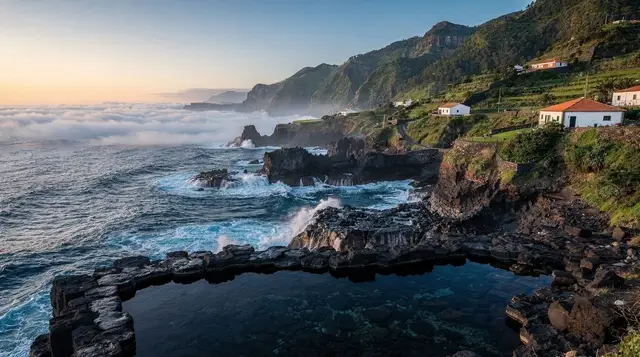
Two days in, I drove up and over to Porto Moniz for the natural pools, and the island changed completely somewhere around the tunnels through the central massif. The south had been dry and bright that morning; the north was under low grey cloud with a fine, persistent rain that never quite stopped for the rest of the day. The pools were closed to swimmers because the winter swell was breaking over the rocks — worth checking ahead of time rather than assuming, because this happens routinely in January. I stood and watched the water instead, which was its own kind of spectacular, but it wasn’t the trip I’d pictured that morning in a t-shirt.
This is the trade Madeira makes you in January: the wet season concentrates in the north, and it isn’t polite about warning you before you drive over the hill. I checked the IFCN trail status most mornings after that, because two of the levadas I’d hoped to walk were closed for a few days after heavy rain — a landslip risk, not bureaucracy, and worth respecting.
Above the Cloud Line: Snow on the Peaks
The genuine surprise of the week was going up. I’d booked a guided hike up toward the high peaks assuming brisk and blustery, and instead found frost on the boardwalks near Pico do Arieiro and a dusting of snow further along toward Pico Ruivo that our guide said had fallen two nights earlier. It wasn’t deep, and it was gone within a day, but it was real snow, at altitude, an hour’s drive from a beach town where I’d been in a t-shirt that same morning. Nobody had mentioned that possibility to me before I went, and I think it’s the single most underrated fact about a Madeira winter.
The nights up there were also the clearest I’ve seen anywhere, cold enough to need a proper coat, and I went back a second evening for a stargazing session at Pico do Arieiro that made the early alarm and the cold entirely worth it — winter air at that altitude is drier and stiller than summer’s, and it shows. If you’d rather see the same ridgeline without ice underfoot, there’s sound advice on dressing for mountain weather worth reading before you go, whatever month you’re in.
The Island After the Fireworks
The quiet was the part that matched the promise. Restaurants in Funchal’s old town that I’m told need booking in August took walk-ins without blinking. The queue for the Monte cable car was five minutes, not fifty. A levada walk out toward the mountain lakes that I’d expected to share with a busload turned out to have almost nobody on it — just me, a local dog walker, and the sound of water in the channel. That’s the real case for January: not that the weather is guaranteed, but that the island gives you room to actually be in it.
I’d planned a day trip to Porto Santo as well, and this is where I’d tell anyone reading not to build a tight itinerary around it in winter. My ferry sailing was cancelled the afternoon before, with no warning beyond an app notification, because of swell in the channel — the crossing runs on Atlantic winter conditions, and it is not something you can count on the way you might in July. I flew instead, on short notice and at a worse price than I’d have paid booking ahead, and it worked out, but only because I’d left a spare day in the schedule rather than pinning everything to that one crossing.
What I’d Do Differently
Next time I’d build in more slack on both ends: a spare day for the north if the rain closes a trail I want, and a spare day around any Porto Santo plan rather than a same-day return. I’d also pack for three climates rather than one, because that’s genuinely what the trip asks of you — sandals for the promenade, a proper waterproof for the north coast, and a real coat for anything above a thousand metres. What I wouldn’t change is the timing itself. A quiet levada, a cold clear night on the ridge, and a warm coastal afternoon in the same week is a combination the busier months simply can’t offer.
FAQ: What January in Madeira Is Really Like
Is Madeira warm enough to visit in January?
Funchal and the south coast typically sit around 19-21°C in January, mild enough for a t-shirt by day, but the north coast runs several degrees cooler and wetter, and the high peaks can drop to frost or light snow overnight.
Can you swim in Madeira in January?
The sea runs about 18-19°C off Funchal, which is swimmable for anyone used to cool water, though most visitors stick to hotel pools and only a few brave the sea in January.
Does it snow in Madeira?
Occasionally, above roughly 1,500 metres around Pico do Arieiro and Pico Ruivo, usually as a light dusting that melts within a day or two rather than settling for a season.
Are levada trails open in January?
Some close temporarily after heavy rain due to landslip risk, particularly in the wetter north; checking the official trail status before setting out is worth doing every morning of a January trip.
Is the Porto Santo ferry reliable in winter?
No — winter swell in the channel causes regular cancellations, so a January day trip to Porto Santo should never be the only plan for that day, and flying is a safer backup than counting on the boat.
Is January a good time to avoid crowds in Madeira?
Yes, once the New Year period ends in early January the island is markedly quieter than any other month bar parts of November, with shorter queues at Monte and easier restaurant bookings in Funchal.
What should I pack for Madeira in January?
Layers for three different climates in one day: light clothing for the coast, a proper waterproof for the north, and warm layers for the peaks, where temperatures can sit close to freezing before dawn.
tours.Seasons
Verified deep-linked GetYourGuide tours. Book through these links and we earn a small commission at no cost to you.
GetYourGuide does not provide a product photo for this activity — the image shows the meeting point, photographed by us.