Paragliding in Madeira: Flying Over Arco de São Jorge
Is paragliding in Madeira reliable, or does it get cancelled a lot?
Paragliding in Madeira is entirely weather-dependent, and cancellations for wind are common, especially on the exposed north coast near Arco de São Jorge. A typical tandem flight launches from a high viewpoint above the coast and lasts around 15 to 25 minutes in the air, but no operator can promise a flight will go ahead on any given day.
The one air-sports page on this site, and why it starts with a warning
Madeira has a single serious paragliding scene, and it revolves almost entirely around one launch: the hillside above Arco de São Jorge, on the island’s exposed north coast. If you search for the activity you will find enthusiastic photos of pilots and passengers hanging above a green coastline with black cliffs and white surf below, and every one of those photos represents a flight that happened on a day when the wind cooperated.
What the photos do not show is how often it does not. This page exists to give you the realistic picture: how the flight works, what the wind and terrain actually do at this site, what a booking looks like in practice, and why you should treat any tandem paragliding slot in Madeira as provisional until the pilot rigs the wing and tells you it is on.
That last point matters enough to repeat before anything else. Nobody who flies paragliding tandems at Arco de São Jorge for a living will promise you a flight in advance, and you should be suspicious of anyone who does. The site’s whole appeal, an open ridge facing the Atlantic with nothing in front of it, is also its whole vulnerability: it takes the wind straight off the ocean with no coastline or high ground to soften it first.
Why Arco de São Jorge, specifically
Madeira’s north coast is a long run of steep, green slopes dropping to a shoreline with almost no shelter, and most of it is either too built up, too broken by ravines, or too enclosed by higher ground behind it to work as a paragliding launch. Arco de São Jorge is the exception.
The hillside above the village rises cleanly from the sea with an open, grassy face and a wide enough approach for a pilot to lay out a wing, run the passenger down the slope, and get airborne before the ground falls away beneath them. Below the launch, the terrain drops toward the coast road and the shoreline near Santana, giving pilots a long, scenic glide with a clear landing zone at the bottom rather than a cramped clifftop with nowhere safe to put a wing down.
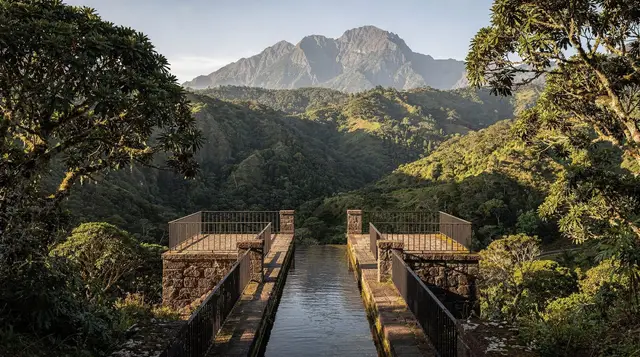
The view is the other half of the appeal. On a flying day you see the terraced hillsides that grow the bananas and vines this stretch of coast is known for, the low sugarloaf shape of Penha de Águia further along, and the open Atlantic stretching north with no other landmass for hundreds of kilometres. It is one of the more striking aerial perspectives on the island precisely because the north coast is the greenest, most dramatic side of Madeira, and paragliding is the only way most visitors will see it from above rather than from a car window or a viewpoint.
A smaller number of flights launch from slopes near Boaventura and Faial when the wind direction at Arco de São Jorge is wrong for that specific site but still flyable somewhere nearby. These are backup options an operator switches to on the day, not something you book separately, and they exist because a working pilot needs more than one option on a coast where the wind rarely does the same thing two days running.
Wind and thermals: what actually decides your flight
Paragliding needs wind within a narrow band, not the absence of wind. Too little and the wing will not stay pressurised and flying; too much, or wind coming from the wrong angle, and launching becomes dangerous rather than merely uncomfortable. At Arco de São Jorge the operative wind is a light to moderate northerly, blowing cleanly onto the slope so it deflects upward along the ridge and gives the wing lift to climb rather than just glide down. This is called ridge lift, and it is what keeps a paraglider in the air for longer than a straight descent from the launch height would otherwise allow.
The problem is what sits behind that same geography. There is no buffer between the open Atlantic and this launch, so any weather system pushing wind onto the north coast, whether from the north, north-east or north-west, arrives here at close to full strength with no coastal range to slow it first. A forecast that shows a manageable breeze in Funchal on the sheltered south coast can mean a stiff, gusty wind at Arco de São Jorge, because the two coasts genuinely experience different weather on the same afternoon. Consult a mountain weather and what to wear guide before you assume a calm morning in your hotel means a calm morning at launch; the two are not the same thing on this island.
Thermals, the rising columns of warm air that paraglider pilots use to gain height away from the ridge itself, are less central to a typical Madeira tandem than the ridge lift is, but they still shape the flight and the timing an operator picks. Thermal activity builds through the morning as the sun warms the slopes, which is one reason many operators try to fly earlier rather than later: enough warmth to add some lift, not so much that the air turns rough and thermic, which makes for an uncomfortable rather than scenic ride for a first-time passenger. Afternoon flights are more likely to be bumpy, more likely to see the wind pick up and shift direction, and more likely to be the ones an operator cancels first if the day is marginal.
The tandem flight, step by step
Every commercial paragliding flight in Madeira is a tandem, meaning you are harnessed in front of an experienced, licensed pilot who controls the wing throughout. There is no solo option offered to visitors, and that is deliberate: this is not a site or a wind pattern that suits a first-time flyer working alone.
A typical booking runs roughly like this. You are collected from your accommodation, usually in or near Funchal, and driven across the island to Arco de São Jorge, a trip of around 40 to 50 minutes depending on where you are staying and the exact launch used that day. At the launch site your pilot fits you into a harness, checks the wing, and gives you a short briefing on the run and the landing, since the only active thing you are asked to do is run a few steps downhill at launch and lift your legs for landing; the pilot handles everything else, including the wing itself, throughout the flight.
The flight lasts somewhere between roughly 15 and 25 minutes in typical conditions, longer on days with good ridge lift and shorter on weaker days, and covers the glide from the launch height down toward a landing zone near the coast. Most operators or their photographers capture the flight on a helmet-mounted camera or a second in-flight camera and offer photos or video as an add-on; this is worth asking about in advance if it matters to you, since it is not always included as standard. After landing you are typically driven back to Funchal, making the whole outing, door to door, a half-day activity even though the flight itself is short.
If you would rather see this stretch of coast without leaving the ground, the same terrain that makes Arco de São Jorge work for paragliding is visible from sea level on the boat trip along Madeira’s north coast, which passes below these same cliffs and gives a very different, equally dramatic view of the same green slopes.
Why your flight might not happen, and what to do about it
This is the part most guides skip, and it is the part that actually matters for planning your trip. Because Arco de São Jorge is fully exposed to the open Atlantic, the margin between a flyable day and an unflyable one is thin, and it can change within hours. A morning that looks calm from your hotel balcony in Funchal can turn out gusty at the launch, and a forecast that looked promising two days out can shift by the time your slot arrives. Operators cancel or postpone flights regularly, sometimes with only a few hours’ notice, and a responsible one will tell you plainly that a booking is a provisional slot, not a guarantee.
The practical response to this is straightforward. Book earlier in your stay rather than on your last full day, so that a cancellation leaves room for a second attempt rather than forcing you to skip it entirely. Keep your schedule for that day loose rather than stacking it against a tight dinner reservation or a ferry to Porto Santo, since a delayed decision on the wind can mean the flight moves by a few hours at short notice. And treat the whole thing as a bonus activity to try, not the centrepiece your trip depends on; the island offers plenty else to fill a day that turns out too windy to fly.
If your slot is cancelled, the north coast around Arco de São Jorge is still worth the drive on its own terms. The village itself, along with neighbouring Boaventura and the thatched houses of nearby Santana, makes for a solid half-day even without a flight, and a private 4x4 tour of the north-east coast or a guided photography day through the north-west covers similar scenery from the ground with far less dependence on a single narrow wind window.
Best time of year and time of day
There is no month in Madeira that guarantees flyable paragliding conditions, and none that rules it out entirely; the island’s weather is simply too changeable for that kind of promise, and the honest answer sits somewhere between the extremes.
| Period | General pattern at Arco de São Jorge | What it means for booking |
|---|---|---|
| Late spring to early autumn (roughly May to September) | More settled, lighter wind days on average | Best statistical odds of a flight going ahead, still not guaranteed |
| Winter (roughly November to March) | More frequent frontal systems bringing stronger, gustier wind | More cancellations; book with flexible days either side |
| Early morning | Generally calmer, before daytime heating builds thermal turbulence | Most operators’ preferred and first-offered slot |
| Afternoon | More thermal activity and a greater chance of the wind picking up | More likely to be bumpier, more likely to be the first slot cancelled on a marginal day |
Read this table as a guide to your odds, not a schedule you can plan against with certainty. A calm week in July can still include an unflyable Tuesday, and a blustery February can still produce a still, clear Thursday morning that turns out perfect. If your trip falls in the quieter winter months, pair a paragliding booking with a broader look at Madeira in winter so you are not relying on one activity to make the week.
What to bring, what to wear
Dress for wind and altitude, not for the beach weather you may be having in Funchal that same morning. Closed shoes such as trainers or light walking shoes, long trousers rather than shorts, and a windproof layer over a t-shirt cover most conditions at launch, since the open ridge at Arco de São Jorge can feel notably cooler and windier than the sheltered south coast even on a warm day. A light waterproof is worth having in the car for the drive, given how quickly the north coast’s weather can turn.
Secure anything loose before you get near the launch. Hats, sunglasses left un-clipped, and anything in an open pocket have a tendency to leave you the moment you are running downhill into wind, and there is no retrieving something that goes over the cliff edge. Sunglasses with a strap, and a phone in a zipped pocket rather than a hand, solve most of this.
Beyond that, come with reasonable expectations rather than a packed schedule either side of your slot. A short debrief with the pilot after landing, a look at the photos or video if you booked them, and the drive back to Funchal typically round out the outing to somewhere around three to four hours door to door, even though the flight itself is measured in minutes.
Making the most of a windy day
Because cancellations are a normal, expected part of this activity rather than a sign something went wrong, it is worth having a plan for the rest of that day before you even arrive at the launch. The north coast between Porto da Cruz and Arco de São Jorge rewards a slow drive on its own merits, with viewpoints, small cafés, and the terraced hillsides that make this side of the island look so different from the sunbaked south.
A 4x4 tour through the emerald forest and waterfalls covers some of the same interior terrain from a vehicle rather than the air, and works regardless of what the wind is doing that day.
It is also worth checking whether your operator offers any flexibility to move a cancelled slot to another day within your stay rather than simply refunding it outright; many do, and it is the single best way to improve your odds of eventually catching a flyable window without giving up an entire day twice over. For general planning around Madeira’s shifting weather, the wider best time to visit Madeira guide and the north versus south Madeira comparison both explain why this coast behaves so differently from the resort areas most visitors see first, and why a plan that only accounts for Funchal’s forecast will let you down here.
Booking sensibly
Choose an operator who is upfront about weather dependency rather than one who avoids the subject, and be wary of any booking platform description that implies a flight is certain. A pilot who cancels readily on a marginal morning is not being overly cautious; they are the reason this activity has a good safety record at a site with no margin for error if the wind turns nasty mid-flight. Ask in advance what the rebooking or refund policy is for a weather cancellation, since this varies between operators and matters more here than it would for an activity less tied to a single narrow wind window.
If you are building paragliding into a wider north-coast day, pair it with things that do not depend on the same conditions. A walk through Santana’s thatched houses, a coffee in Faial looking out at Penha de Águia, or simply following the coast road toward Porto da Cruz all work regardless of wind, and turn a cancelled flight into a good day rather than a wasted one. For a broader sense of what else sits on this side of the island, the north Madeira day trip guide lays out a full itinerary that a paragliding slot can slot into rather than anchor.
Frequently asked questions about paragliding at Arco de São Jorge
Where do paragliding flights in Madeira take off from?
Almost all tandem paragliding in Madeira launches from the hills above Arco de São Jorge on the north coast, where a grass or dirt ramp faces open sea and the Atlantic swell breaks against black cliffs below. A handful of operators also fly from sites near Boaventura and Faial when the wind favours those slopes instead.
Is Arco de São Jorge the only place to paraglide in Madeira?
It is the site every commercial operator actually uses on a normal day, because it is the launch with the most reliable ridge lift and the fewest obstacles on the north coast. Other north-facing slopes near Boaventura and Faial exist as backups when the wind direction at Arco de São Jorge is wrong.
How long does a tandem paragliding flight last?
A standard tandem flight in Madeira runs from around 15 to 25 minutes from launch to landing, depending on the lift available that day. In strong thermal conditions a pilot can extend a flight considerably by working rising air along the ridge; in weak conditions the glide down is shorter.
Do I need experience to paraglide in Madeira?
No. Every commercial flight in Madeira is a tandem, meaning you fly strapped in front of a licensed pilot who does the launching, flying and landing, so no prior experience or fitness beyond being able to walk a short distance and run a few steps at launch is required. Solo paragliding courses exist but are a separate, longer product aimed at people already learning the sport.
Why do paragliding flights get cancelled in Madeira?
Arco de São Jorge sits directly on the north coast with nothing between the launch and the open Atlantic, so it takes the full force of any northerly or north-easterly wind, and paragliding needs wind within a fairly narrow speed and direction window to be safe. Gusty, cross or overly strong wind, low cloud sitting on the ridge, or rain anywhere along the north coast all lead to a cancelled or postponed flight, sometimes with only a few hours’ notice.
What should I wear for paragliding in Madeira?
Trainers or walking shoes, trousers rather than shorts, and a windproof layer, since the launch sits in open wind at altitude and can feel considerably colder than Funchal. Sunglasses and a way to secure loose items such as hats are worth having, since anything not fastened down tends to leave you at launch.
Is paragliding in Madeira safe?
Tandem paragliding with a licensed, insured operator is a well-regulated activity, and pilots who fly Arco de São Jorge daily know the site’s wind behaviour closely and will decline to fly rather than take an unsafe launch. As with any adventure sport there is inherent risk, and the honest safety measure is an operator who cancels readily rather than one who flies in marginal conditions to avoid disappointing a client.
What is the best time of year for paragliding in Madeira?
Late spring through early autumn tends to bring more settled, lighter wind days on the north coast, though flyable mornings occur across the calendar and unflyable ones occur in every month too. Mornings are generally calmer than afternoons, which is why most operators try to book flights before midday whenever the forecast allows it.
tours.air-sports
Verified deep-linked GetYourGuide tours. Book through these links and we earn a small commission at no cost to you.
GetYourGuide does not provide a product photo for this activity — the image shows the meeting point, photographed by us.