Madeira's Gardens: Botanical Garden vs Quinta do Palheiro
What's the difference between Madeira's Botanical Garden and the Quinta do Palheiro?
They are two separate gardens on opposite sides of Funchal. The Botanical Garden is a public, terraced hillside collection above the city, strong on cacti, succulents and formal bedding. The Quinta do Palheiro Ferreiro is a private family estate garden a short drive east, built around mature trees, camellias and an English-style landscape. Neither substitutes for the other.
Two gardens, often mistaken for one
Ask three visitors what they saw at “the botanical garden” in Madeira and you may get three different answers, because at least two separate places share that reputation, and a third often gets folded into the confusion. This guide sorts out the two that matter most: the Funchal Botanical Garden, a public hillside park above the city, and the Quinta do Palheiro Ferreiro, a private estate garden on the other side of town. They are not two names for the same place, they are not run by the same owners, and they do not look remotely alike once you walk through the gate. If you take away only one fact from this page, take that one.
There’s a third name worth clearing up while we’re at it. The Monte Palace Tropical Garden, up at Monte above the cable car terminus, is a third distinct garden again, with its own separate history and character. We cover the Botanical Garden and the Quinta do Palheiro in depth here; if your real question is Monte Palace versus the Botanical Garden, that’s a genuinely close call between two very different experiences, and we’ve given it its own page: see our Monte Palace versus Botanical Garden comparison rather than a rushed verdict tacked on here.
The Funchal Botanical Garden
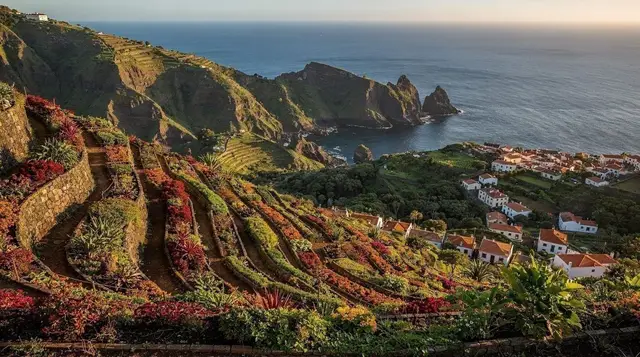
The Botanical Garden sits on a steep hillside above eastern Funchal, laid out on terraces that step down the slope with the city and the bay spread out below. It was established from the grounds of the Quinta do Bom Sucesso in the 1960s and has been run as a public garden ever since, which is the first structural difference from the Quinta do Palheiro: this one belongs to the public, is open every day of the year, and charges a modest entry fee rather than operating as a private estate.
What you’ll actually see is a mix of formal and botanical. Near the entrance, geometric beds of bedding plants and clipped hedges are arranged in tight patterns, the kind of postcard shot most visitors leave with. Further into the garden, the collection turns more serious: a substantial cactus and succulent collection on the drier upper terraces, palms, a section devoted to plants endemic to Madeira and the wider Macaronesia region, and views back over Funchal that keep pulling your eye from the plants to the harbour. There’s also a small natural history museum and an aviary on site, which makes the garden a reasonable half-day out even without factoring in the planting.
Getting there is straightforward without a car. The Monte cable car from the old town is the scenic route, followed by a second cable link or a short bus ride down to the garden gate; taxis and several of the tuk-tuk tours that circulate through the Zona Velha also stop here directly, which is worth knowing if you’d rather not manage two cable car changes with children or heavy bags. Because it’s terraced and built into a hillside, expect paths, ramps and some steps rather than flat, even ground throughout.
The Quinta do Palheiro Ferreiro
The Quinta do Palheiro Ferreiro, often shortened locally to just “Palheiro,” is a different kind of place entirely. It’s a private family estate on the eastern edge of Funchal, still connected to the Blandy family, whose name you’ll also see on the wine lodge in the old town. Where the Botanical Garden is public parkland laid out for visitors from the start, the Quinta do Palheiro grew as the working garden of a private house, planted and expanded over nearly two centuries, and it still reads that way: less curated for photographs, more like walking through someone’s inherited passion project at a genuinely grand scale.
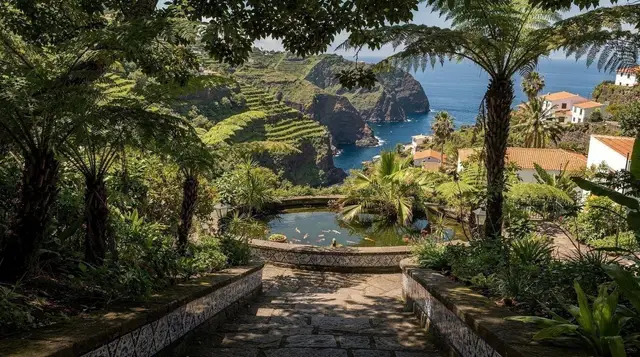
The planting style leans English landscape garden rather than formal terracing. Mature trees, some well over a century old, structure the grounds, with sweeping lawns, a lake, and paths that wander rather than step down a slope in straight lines. The estate is particularly known for its camellia collection, one of the most significant outside East Asia, and for magnolias, azaleas and a wide range of subtropical and temperate species that thrive in Madeira’s unusually mild, humid microclimate. Spring, especially the camellia and azalea season, is when the garden is at its most spectacular, though there’s structural interest here in any month.
The Quinta do Palheiro is open to independent visitors on a paid ticket, not restricted to organised tours, but its opening days are more limited than the Botanical Garden’s, so it rewards checking hours before you set out rather than turning up on a whim. It sits away from the cable car network, so most visitors arrive by taxi, hire car or as part of a guided itinerary that also covers Monte or the old town.
Comparing the two gardens
| Botanical Garden | Quinta do Palheiro Ferreiro | |
|---|---|---|
| Ownership | Public, run as a city park | Private family estate |
| Style | Terraced hillside, formal beds, cacti and succulents | English landscape garden, mature trees, lawns, lake |
| Signature feature | Bay of Funchal views from the terraces | Camellia and magnolia collection |
| Access | Cable car link, bus, taxi, tuk-tuk tours | Taxi, hire car, or guided tour |
| Opening | Daily, year-round | More limited days; check ahead |
| Best paired with | Monte and the cable car circuit | An east-of-Funchal or estate-focused day |
Neither entry in that table is “the same garden with a different name.” If you’ve read a review or heard a recommendation mentioning one and turn up expecting the other, you’ll be looking at a different plant collection, a different layout and a different atmosphere altogether.
Why Madeira grows so much so well
Both gardens exist because of the island itself. Madeira is volcanic, subtropical and sits in the Atlantic about 900 km from the continent, which gives it a climate with no real dead season: plants that would need a greenhouse elsewhere in Europe simply stay outdoors here. The same mild, humid air that feeds the Laurissilva forest, inscribed by UNESCO in 1999, is what lets a camellia collection or a bed of tropical bedding plants thrive a few kilometres from the sea. If you want to see that wild vegetation in its natural state rather than in a planned garden, our guide to the Laurissilva shows what the gardeners were working from.
The slope matters as well. The island is only 57 km long and 22 km wide, yet it rises to 1,862 m at the Pico Ruivo, so the temperature and the moisture change quickly as you climb. Funchal’s gardens sit at different heights above the bay, and that is part of why they feel so different from one another even though they are a short drive apart.
What to look for in each garden
At the Botanical Garden, start from the top and walk down. The upper terraces carry the cacti and succulents, the middle levels hold the palms and the Madeiran plants, and the formal bedding near the entrance is the part everyone photographs. Take a moment at each turn to look back over the bay, because the views over Funchal change with every terrace. If you are short on energy, do the downhill walk and leave the climb back for a bus or a taxi.
At the Quinta do Palheiro, the reverse applies: slow down and wander rather than aim for a list of sights. Follow the paths past the big trees, find the lake, and give the camellia walk its own stretch of time. Because the estate reads like a private house garden, the pleasure is in the layout and in the age of the trees, not in a single headline view. Visit with a loose plan and let a path lead you somewhere you did not expect.
When to go
Madeira has no off-season, so gardens are worth a visit in any month, but they do change. Spring is the strongest time for the Quinta do Palheiro, with camellias and azaleas at their best, and it is also when the island celebrates flowers in the city: see our Flower Festival guide if your dates line up. In winter the cooler weather suits long garden walks far better than the middle of the day in summer, and the Madeira in winter page explains what to expect from the weather. For a broader view of the year, the best time to visit Madeira page lays out the seasons month by month.
Go early if you can. Mornings are quieter, the light is softer for photographs, and you leave the afternoon free for the rest of the city. Cruise passengers who only have a few hours should read the cruise stop in one day plan before choosing, because a garden and a port day rarely fit together without trade-offs.
Practical tips for both gardens
- Wear shoes with grip. Paths are uneven and can be damp, especially after rain, and the Botanical Garden is built on a slope.
- Bring layers. The weather can shift between the coast and higher ground, and our what to pack list covers the basics.
- Carry water and a hat. Shade is patchy on the upper terraces of the Botanical Garden.
- Check opening hours before you set out, particularly for the Quinta do Palheiro, which opens on fewer days.
- Allow a taxi or a hire car for the Quinta do Palheiro; see getting around without a car if you are not renting one.
- Keep the camera ready, but do not rush the walk to chase photographs. The photography spots guide covers where the island’s best frames are.
Gardens with children and slower walkers
Both gardens work for families, though in different ways. The Botanical Garden has the aviary and the small natural history museum, which give younger visitors something to look for between the plant beds. The Quinta do Palheiro offers lawns and a lake, with space to move around. Neither is flat, so a sturdy pushchair or a carrier is more comfortable than a lightweight one. For more ideas on keeping a family day easy, see Madeira with kids and the family-friendly walks collection.
Slower walkers should plan for the gradients. The Botanical Garden’s terraces involve slopes and some steps, so pace yourself, use the benches and decide in advance whether you will walk back up or take a taxi. The Quinta do Palheiro’s grounds are gentler underfoot, but the surfaces vary and the estate is large, so it is best taken in short stages with rests.
Seeing them by tuk-tuk or guided tour
Because the Botanical Garden sits within reach of the old town’s tuk-tuk circuit, several operators combine a Zona Velha loop with a run up to the garden gate, which suits visitors who’d rather skip the cable car changes or who are short on time. If that’s your preference, the Funchal Orchid Garden and Old Town tuk-tuk tour works the Botanical Garden into a wider loop of the city’s painted doors and viewpoints, and the Botanical Gardens and Old Town tuk-tuk tour is built specifically around this garden and the streets below it.
For visitors who want to see the Quinta do Palheiro alongside Monte’s cable car and gardens in a single organised outing rather than arranging taxis for each stop separately, the Botanical, Monte Palace and Palheiro Gardens tour covers all three in one day with transport included, which is the most efficient way to see the full spread of Madeira’s garden heritage without renting a car.
If you’d rather keep Monte and its own tropical garden as a separate, more relaxed outing with a drink stop built in, the Monte Palace Garden and Old Town private tuk-tuk tour is a smaller-scale alternative.
Building a garden day around the rest of Funchal
A garden visit sits well next to other city stops. A morning at the Botanical Garden can be followed by lunch and a walk through the old town; our Funchal Old Town and painted doors guide describes what to see there. The Mercado dos Lavradores is a good place to buy fruit and flowers afterwards, and the Madeira food guide helps you choose where to eat. If you would rather finish the day with a glass of something local, the Madeira wine tastings in Funchal page lists the options.
For visitors with several days, gardens fit comfortably into a longer plan. The three days in Madeira and one week in Madeira itineraries both leave room for a slow garden morning, and the Madeira first-timers week shows how it can sit between more active days. If rain turns up, a rainy-day plan for Madeira suggests alternatives, though gardens are among the better wet-weather options because the plants look fresh.
Planning your garden day
If you’re building a wider Funchal itinerary and gardens are only one piece of it, our one day in Funchal guide slots either garden into a fuller circuit alongside the old town, the market and the Monte cable car. Garden visits also pair naturally with the Blandy’s Wine Lodge tasting in the city centre, since the Blandy family connects directly to the Palheiro estate, and with a stop at Santa Catarina Park for a shorter, free green space if your itinerary won’t stretch to a full estate visit.
Whichever garden you choose, or if you manage both, allow more time than you think. The Botanical Garden’s terraces are steeper than photographs suggest, and the Quinta do Palheiro’s grounds are large enough that a rushed hour barely covers the lake and the main camellia walk. Neither garden is a quick add-on between bigger sights; each earns a proper morning or afternoon on its own terms, and treating them as interchangeable stops on the same list is the fastest way to leave both feeling shortchanged. For the head-to-head question of which one to prioritise against Monte Palace specifically, our Monte Palace versus Botanical Garden guide walks through that decision properly.
Gardens, quintas and botanical visits on GetYourGuide
Verified deep-linked GetYourGuide tours. Book through these links and we earn a small commission at no cost to you.
GetYourGuide does not provide a product photo for this activity — the image shows the meeting point, photographed by us.